I always make a point of sharing Quincy Davis' video lessons from his ongoing Q-Tips series on YouTube. The information and content that he shares is important, informed and always presented in a very clear and concise manner. His series is highly recommended, in my opinion.
However, I am making a point of sharing this specific video today in which Quincy deals with different approaches to playing in TWO.
I've made an observation over the past few years that a significant number of drummers don't know how to play in "2". I feel that this a very important groove and concept that every aspiring jazz drummer must consider, study and master.
Quincy lays it all out in his wonderful video. Check it out, get to work and keep swinging.
Please join us for our next episode of Four on the Floor *Live* happening this Wednesday, May 29th at 7pm MST (9pm EST), appearing on Instagram IGTV @fouronthfloorblog featuring Timothy Roberts.
We'll be talking all about the art of making drums and cymbals and whatever else happens to be on our mind...
Timothy is a professional studio and live musician with 50+ album credits and extensive work as an on-call musician. His passion for sound exploration led him to crafting the instruments that he plays.
Our team consists of only a few highly trained and skilled craftsmen who are all musicians. We have a value that every piece we make is crafted with care and attention to detail. We don’t sell anything we wouldn’t (or haven’t) used in musical situations ourselves!
Timothy Roberts Handcrafted Cymbals are made with the highest quality B20 bronze, hand-hammered, and lathed into incredibly expressive and nuanced cymbals for all styles. Whether you have an old cymbal you’d like reworked or you’d like a custom creation, we are dedicated to bringing out the best a cymbal has to offer.
Reverie Drum Co. employs unique drum designs and specs to provide the highest quality sound possible. Our drums are made with thinner shells, minimal hardware, and instrument-grade finishes to enhance the sustain and tone. This allows for smaller sized kits to have incredible beefy and big sounds. These drums are the most inviting and inspirational we’ve played, and we think you’ll agree!
And...we're back. Hope all is well in your part of the world and thanks for checking in.
This is the May 2024 edition of The Monday Morning Paradiddle, a more-or-less monthly collection of various items of interest, for your pleasure and enjoyment.
Hey! It's the 15th anniversary of my blog and the classic black Four on the Floor t-shirts are now back in stock and once again available!
These shirts are available in small, medium, large, x-large and xxl sizes and are lightweight premium fitted 100% cotton tees.
The shirts are $30 each (+shipping)
If you are interested in purchasing one, please drop me a line asap at fouronthefloorblog@gmail.com or reach me through social media and I'll set you up asap.
These are only available in limited quantities and last time these went pretty quickly so don't delay and order today while supplies last!
The Monday Morning Paradiddle - May 2024
1. Another series of great articles from Vinnie Sperrazza's Substack Chronicles including pieces on:
I am going to resume my annual Instagram interview series, at least for a few weeks this Spring. I started doing this back in December 2020 during Covid and have been doing this on and off for four years now.
Please join us for our next episode of Four on the Floor *Live* happening this Thursday, May 23rd at 7pm MST (9pm EST), appearing on Instagram IGTV @fouronthfloorblog featuring the one and only Chad Anderson!
We'll be talking about drums, drumming, drummers, cymbals and whatever else happens to be on our mind...
Thanks to Timothy Roberts of Reverie Drums for sharing these fantastic videos of Geoff Clapp playing and discussing the nuances of Tim's very fine artisan drums and cymbals. Tim is the real deal and doing incredible work these days. Check him, his drums and cymbals out here: www.reveriedrums.com
Clapp is a good friend and he always takes time to answer my texts back and forth. I've learned a lot from him, spending several Zoom sessions with him over the years, taking lessons on aspects of groove. His understanding of New Orleans drumming is deep. He teaches from lived experience and he's a really great educator. If you get a chance, find a way to connect with Dapper and you won't regret it!
Check him out and Timothy Roberts' drums and cymbals here:
Craig VanDerSchaegen also recently interviewed Geoff for his wonderful podcast series and blog The Practicing Drummer so make sure to check this out as well:
Some inspiring drumming this morning to get the week off to a good start with a birds-eye drum view of some ferocious trading from Kendrick Scott and Terence Blanchard:
It's the 15th anniversary of my blog and the classic black Four on the Floor t-shirts are now back in stock and once again available!
These shirts are available in small, medium, large, x-large and xxl sizes and are lightweight premium fitted 100% cotton tees.
The shirts are $30 each (+shipping)
If you are interested in purchasing one, please drop me a line asap at fouronthefloorblog@gmail.com or reach me through Facebook/Twitterland/Instagram and I'll set you up asap.
These are only available in limited quantities and last time these went pretty quickly so don't delay and order today while supplies last!
Lewis Nash is sporting his classic black Four on the Floor t-shirt and so can you!
Well, as they say, "Time flies when you're having fun..."
I was contemplating what to write and share today and then realized that I've reached a bit of a milestone here: April 2024 represents the 15th anniversary of my blog Four on the Floor.
(no...not that Milestone(s) but you should still listen to that album anyways!)
It's hard to believe that I started this project way back in the Spring of 2009. I was still living in Toronto at the time, preparing to write my candidacy exam for my doctoral studies at the University of Toronto and also packing boxes for an upcoming move to Calgary, Alberta where I still live and work today.
I was inspired by what my friend Chad Anderson had done with his iconic web forum Cymbalholics and was also really digging the regular blog offerings by other on-line jazz citizens such as Darcy James Argue, Ethan Iverson, Ronan Guilfoyle and Peter Hum. Recognizing that I needed some kind of regular web presence to get my name out there (keep in mind that I didn't have a proper website at the time and Facebook, Instagram, Twitter, social media, etc. were still non-existent and non entities in my day-to-day life...ah the good old days!) I spontaneously created a blogger account one April morning as I was drinking my espresso and contemplating ways that I could put off reading some chapters for my upcoming exam...and Four on the Floor was born!
Anyways, a lot as happened career-wise since my first blog post and I had no idea at the time that what I would share and happen to find interesting in the wide world of jazz drumming would be so well received around the world. When I share something it's because I dig it and I hope you will too!
I would like to thank Chad Anderson, John Riley and Adam Nussbaum in particular for their ongoing encouragement to keep this thing going.
Thanks to all of you out there for all your continued support, good vibes and to all of you who regularly read what I have to share.
Sincerely,
Jon McCaslin
btw - okay here's some real jazz drumming content to check out today featuring Art Taylor with Johnny Griffin (or as Joe Farnsworth would say: "RIP!")
"The guys get shirts..."
- Paul Anka
Well you don't have to be a guy and you certainly don't need Paul Anka's permission to celebrate the 15th anniversary of my blog in style by wearing the classic black Four on the Floor t-shirt.
The classic black Four on the Floor t-shirts are now back in stock and once again available for a limited time only!
These shirts are available in small, medium, large x-large and xxl sizes and are lightweight premium fitted 100% cotton tees.
Logo design by Chad Anderson and quality t-shirts printed by Primal Screen (Calgary, AB)
The shirts are $30 each (+shipping)
If you are interested in purchasing one, please drop me a line asap at fouronthefloorblog@gmail.com or you can reach me through Facebook/Twitter/Instagram and I'll set you up right away.
The last few times these went pretty quickly so don't delay and order one today while supplies last!
John Riley and Adam Nussbaum wear their Four on the Floor t-shirts and so can you!
Hey, you've made this far so subscribe to Four on the Floor today!
Please consider entering your e.mail address on the right side of the page to subscribe to my mailing list. Don't miss out, subscribe today and receive Four on the Floor directly to your inbox!
Just click on the link that looks like the icon below, located on the right hand side of the page to subscribe to my mailing list via Mailchimp.
A trio of talented MacEwan drum students have organized the first ever MacEwan Drum Symposium!
I am super excited to present a masterclass on drum set creativity for the upcoming This is Rhythm drum and rhythm symposium at Grant MacEwan University (Edmonton, AB) on Sunday, April 28th at 230pm, joining some great drummers including Efa Etorama Jr., Robert Kpongo, Dave Laing, Daniel Akira Stadnicki, Mark Segger and more!
This two-day series of presentations and performances will bring together some of Edmonton’s finest drummers and percussionists representing a variety of styles.
The event is completely FREE to attend and will also feature numerous giveaways.
One of the organizing students, Tony Flanagan, had this to say: “This is project is something myself, Braeden Detert and Jonas Hazelaar have been working on throughout the year, and has taught us a ton about the grant application process and event management. I think we’ve put everything in place for a great two days, with a lot of engaging presenters on a variety of topics. I hope to see everyone there!”
A wonderful interview with the great Lenny White and a couple short clips of the Master in action, demonstrating some very serious and very hip independence solo ideas!
Please consider contributing to my friend Ted Warren's Go Fund Me campaign to help fund the release of his latest solo drumming recording project: Drum Stories
Ted is a fellow Canadian jazz drumming blogger, a helluva musician and a good friend. He is also one of the most creative and hard working drummers that I know. His musical curiosity, rhythmic imagination and hard work ethic (this guy really knows how to practice!) have always impressed and inspired me, even going back to when I was just getting into jazz drums back in the early 90s. When I was coming up Ted was already making a name for himself in Toronto as an in-demand sideman, playing with Rob McConnell & the Boss Brass and saxophonist Mike Murley's quartet (among many others). Even back then Ted played with a unique and dynamic voice on the drum set. Nobody else plays like Ted and I've always appreciated his clever and creative approaches to making music on the drums.
And I've always really dug Ted's original compositions and imaginative approach to music, in particular the music he's composed for his band Ted's Warren Commission. Now I'm very excited about his upcoming solo drum project and looking forward to hearing what he's come up with this time.
I usually make a point of sharing Quincy Davis' videos from his ongoing Q Tips series on YouTube but I ran out of space/time during my last blog post (!)
Anyways, I always share Q's videos because his content is spot on and his explanations are concise, clear and very well done (and of course he plays his a*s off too!) I always learn something when I check out Quincy's newest videos. So bookmark his YouTube channel, check them out and get to work.
Make sure to visit Quincy's website too www.quincydavisjazz.com and check out his excellent jazz drumming vocabulary e-books and excellent play-a-longs.
Thanks for checking in and here is the March 2024 edition of the Monday Morning Paradiddle for your perusal, my more-or-less monthly jazz drumming variety column, just in time (depending on where you are anyways) for the upcoming Spring school break.
The Monday Morning Paradiddle - March 2024
1. The Drummer's Pathway podcast with Michael Scott interviews Ted Warren on the topics of creative explorations in jazz and overcoming self doubt
2. A wonderful three-part series on Max Roach from Vinnie Sperrazza in his Substack series Chronicles:
Vinnie, Ethan, Bill and Bret are all offering really great regular and informed content on their Substacks. Consider subscribing and supporting their excellent ongoing work.
6. An interview with Jeff Williams from London Jazz News on his new album In Duo with saxophonist Dave Liebman
A preview today of a fantastic new duet album featuring Lewis Nash on drums and Steve Wilson on alto saxophone, recorded at the Umbria Jazz Festival, a follow-up to their 2014 release Duologue:
A big thanks to Ed Soph who recently shared this collection of wisdom on Facebook. Ed was kind enough to allow me to share his thoughts on my blog below.
As per always, when the Masters speak, we listen.
FIFTY YEARS OF RANDOM THOUGHTS ABOUT PRACTICING, PLAYING AND IMPROVISING ON THE DRUM SET by Ed Soph
If you cannot immediately play something to your or your teacher’s satisfaction it is because the material is NEW, NOT DIFFICULT. New exercises and techniques require new ways of thinking, hearing, and moving. The more you think about what you are doing and how you are doing it the better your problem solving technique becomes. And that is what practicing is really all about: developing the skills to recognize your musical and technical limitations and learning how to overcome those limitations.
Practice your musical and technical weaknesses, not your strengths. If you sound good when you are practicing you are not really practicing.
Make practicing playing. Movement skills are learned by repetition, by trial and error; by learning to correct, to adjust, and to adapt while actually playing. By applying musical frameworks of form, style, tempo, dynamics, rhythm, and melody to your practicing you will practice musically and prepare yourself for the demands of the bandstand.
Hear everything you are playing whether it is repetitive or non-repetitive, written or improvised.
Practice with a metronome to develop your sense of consistent time.
Avoid practicing in your dynamic and tempo “comfort zones”.
Break exercises into their components. Play individual parts before attempting to play the complete pattern. Play individual measures before attempting to play the complete exercise. This allows your mind to understand the process of playing the exercise. It is your brain, not your hands and feet, that plays the drums.
Practicing new material slowly is the quickest way to learn it. Practicing slowly gives you the opportunity to think about what you are doing. If you cannot play it at quarter note = 40-50 you haven’t really mastered the pattern.
“Sing” parts before you play them. “Sing” one part while playing another.
Be patient. Remember, progress is doing, not completing.
Don’t stop if you play something “wrong”. If what you played is in time it is an improvisation, not a mistake! Go with the flow. Let what your brain initially wanted to play come out. That’s you playing. Work your way to the original exercise. In the end, you will have some variations of the exercise because you allowed yourself to make mistakes musically while practicing. The same process occurs when you actually play music in a band so get used to it!
When you hear an accomplished musician, always ask yourself, “Why does he/she sound so good?” If you learn to hear and identify the good attributes in others’ playing you will be able to bring those qualities to your own playing.
Practice thoughtfully. The accomplished players are those who have invested the most time practicing, playing, and thinking about their instrument and the music. They are also the ones who have listened thoroughly to the musical repertoire. They are the players who have developed their ears just as well as their hands and feet.
“Control” comes from degrees of looseness, not tightness.
Explore the musical past. It will help you to understand the present and guide you in charting your own musical future.
Technique is like handwriting. We all learned to make the same basic letterforms when we were taught to write. Yet now we all possess unique styles of writing because we took those basic, fundamental forms and personalized them, thus creating our own “hand”. So it is with drumming techniques. Learn and internalize the basic forms, let your musical imagination go to work, and you will find your own musical “hand”.
For the foundation of jazz/be-bop drumming, time and comping figures should be played with a good, balanced sound. The ride pattern is analogous to the bass pattern, and comping figures to the accompaniment played by the pianist or guitarist. In a musical jazz rhythm section the piano/guitar and the bass are dynamically balanced. And that same rhythm section as voiced on the kit should be balanced as well unless one makes a musical choice to alter that balance. One frequently hears younger drummers playing the ride cymbal much louder than the snare, bass drum and hi-hat. Asked the reason for that, the player will say that the ride cymbal is the “time-keeper” and should be dynamically prominent. By realizing that everything one is playing, repetitive or non-repetitive, is keeping the time solves this problem. In the context of the actual rhythm section it is like the bassist drowning out the pianist or guitarist.
The dynamic level of the music/rhythm section is the accent level. Accents have dynamics. Accents can be soft or loud. The key to musical accentuation is to put softer notes around the note/notes you wish to accent. If the rhythm section is playing mf and one plays a ff accent it will disrupt the time of the rhythm section.
Dynamic consistency is one of the foundations of consistent sounding time.
“Fills” are not solos. The rhythm section is still playing. The “fill” is part of time-keeping. Unless setting up a dynamic change in the music, as in a big band chart, the “fill” should not be softer or louder than the time-keeping that precedes or follows it. Younger players seem to automatically play “fills”, especially when incorporating the toms, louder, as though another drummer is behind the kit.
Big band playing consists of three processes: (1) reading; (2) interpreting what is read by listening to the ensemble while playing; (3) improvising fills and set ups. Let the rhythmic vocabulary of the ensemble figures of the chart determine the content of your improvisations. That’s really playing the chart and not relying on memorized fill patterns that have nothing to do with the music. Play the music, not the chart!
Playing more or faster notes does not necessarily mean playing louder.
Learn to improvise with silence/space as well as sound. As Miles Davis said, “I listen for what I can leave out.”
How you think about the drum set, what you have heard, and what you understand about the musical past of the instrument determine how you play the instrument musically.
Before you can find your “voice” on the instrument you must have a “brain”. This means having your own concept of what you want to do, how you want to do it, and how you want it to sound. Studying other drummers who have a musical “voice” will help you find yours.
Elvin Jones, Roy Haynes, Billy Higgins, Pete LaRoca, and Philly Joe Jones all sound both wonderful and different. What do you think are the musical traits that they share? Those are traits you want to incorporate into your playing, your way.
Don’t make the mistake of just listening to the drummer when you study the music. You are training yourself to listen to yourself on the bandstand if you do. The drummer you are trying to emulate is not listening primarily to him/ her self. He/she is listening to the other musicians. Always listen to the musical environment in which the drummer is playing. Know the tune’s melody and form. Listen to the bassist and drummer; pianist/guitarist and drummer; the soloist and the drummer.
Listen to the entire group.That’s what happens on the bandstand if you have the technical skills and self-confidence to immerse your self in the music, not it your drumming.
Everything you need to know and to hear is in the music. Allow the music or the silence in the music to suggest what or what not to play.
Have a musical reason for what you play and how you play it. If you don’t you will play “filler”, especially on the snare when you don’t have a concept of comping.
Everything you play should have intention. “Filler” or soft “chatter” on the snare should be a choice, not a habit (we practice so that our technique allows us to make choices spontaneously at many tempos and dynamic levels.)
Mimicry is not improvisation. Imagine if you had a conversation with someone who simply repeated what you said. Obviously, there would be no exchange of ideas.
When I was starting out I thought that by mimicking the soloist’s rhythmic ideas I was “interacting” and conversing with him/her. I thought I was showing the soloist that I was really listening! An older pianist was caring enough to tell me, “Don’t play what I play! Just play the tune like everyone else in the band! That was when I started really improvising when I played, not mimicking what someone else played.
“Right” and “wrong” do not nurture improvisational freedom. “Appropriate” and “inappropriate” do. Again, it is a matter of choices.
To have the freedom to listen to the music rather than just ourselves when playing, we must have an extensive musical vocabulary that encompasses dynamics, tempos, sound, styles and repertoire. Without this vocabulary, we cannot communicate with other musicians. The weaknesses that emerge when we don’t have this vocabulary force us to listen to ourselves, because we don’t sound right in the musical situation.
Finally, remember that you sound the way that you move. Drumming is motion. Smooth, in-time motions (strokes) produce smooth, in-time rhythms and sounds. The character of the silent part of the stroke, the upstroke, determines the character of the down stroke, the part that produces the sound. Consider the upstrokes as carefully as the downstrokes.
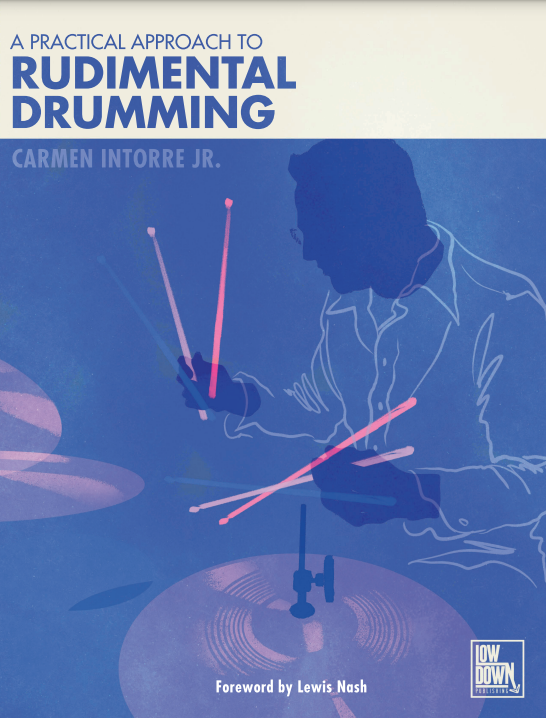
Carmen Intorre Jr. recently released his new book A Practical Approach to Rudimental Drumming. I recently purchased a copy soon after its release and have been working through it lately. Carmen has compiled a wonderful collection of exercises to practice that will undoubtedly improve your technique and musical approach to the snare drum if you take the time. I believe that learning the fundamentals of rudimental drumming is an essential part of any drummer and percussionists training and that this book compliments and adds to the important body of rudimental publications that already exist.
Carmen was nice enough take time out of his busy schedule to answer a few questions about his new book.
A Practical Approach to Rudimental Drumming by Carmen Intorre Jr.- February 2024
1) Tell us all about your new book!
The title of my book is A Practical Approach to Rudimental Drumming. This book is my attempt at helping drummers learn the rudiments and how to apply them around the kit. A major goal of my book is to state the importance of learning and mastering the rudiments. They are essential. In order to have a strong foundation you must learn the rudiments. Having a strong foundation will enable you to grow and achieve your goals on the drums. Think of the importance of learning rudiments in the same way pianists or other instrumentalists learn scales. In the book I introduce different ways to learn and orchestrate rudiments around the kit in hopes to spark ones imagination and creativity.
2) What was the motivation and inspiration for putting together this method?
I started playing the drums when I was four years old and my teachers taught me the importance of learning the rudiments since my very first lesson. I have a strong rudimental foundation. While studying the master drummers I found that they all have studied their rudiments. So with that observation I knew that these are incumbent for us drummers to master. I always found myself trying to play the various rudiments around the kit in different ways that would spark my creativity. I’d play each beat on a different drum, play left hand accents on the high tom, play right hand accents on the floor tom, as many different ways around the kit as possible. When I ask my students to learn this rudiment or that I get a sense of why? I get it that playing these patterns over and over on a pad or a drum can be a bore. In trying to excite them I would sketch out ideas orchestrating the rudiments around the kit for my students. I found that that they were more excited about that than learning traditional way. Although in my opinion there is no substitute to learning the traditional way. With these drum devices you cannot reinvent the wheel but we can try to add to it. Over time I complied many different exercises and when the opportunity to write a book presented itself I knew right away that this would be the subject.
3) How does your book differ from other snare drum method books currently on the market? What makes it unique?
Honestly there are a ton of drum method books out today. I think its great but with that said I’m not hip to all of them. My book is just my humble offering to the drumming world in hopes that someone out there will find it helpful and useful. I’m sort of a traditionalist when it comes to drum methods. My book is no substitute to the “drum bibles” as I like to call them, such as George Lawrence Stone’s Stick Control, Charley Wilcoxon’s Modern Rudimental Swing Solos for the Advanced Drummer, Ted Reed’s Syncopation, Dahlgren and Fine’s 4 Way Coordination. I studied all of these books and their influence on me has shaped my playing and teaching. One may find some small similarities? I feel that my book has the idea of playing music (melody) in mind along with drumming techniques.
4) How do you recommend students and teachers approach working through your materials?
One may have the urge to jump right in and go for it, but I feel it is very important to have a practice routine with goals in mind. When practicing, you should work on the things that you have trouble with. Playing what you already know is ok, but it will not maximize your practice time or help you learn new things. For me, I believe in practicing slowly and gradually working the tempo up. This strategy will not only help you break down the exercises but will often give you clarity. Remember there is nothing difficult; it is either familiar or unfamiliar. When playing through these exercises, give yourself a chance to really learn them. Repetition is the key. Pay close attention to the rhythm and to the sticking indicated, alternate when possible, practice beat by beat, bar by bar, and start to add the following bars until you feel absolutely comfortable with the exercise. Then move on to the next exercise and so on. I also highly recommend recording yourself while practicing so that you can hear exactly what you sound like. Remember to take your time and be patient with yourself. You’ll be able to get the most out of my book this way.
5) What are some of the challenges of putting together a drum method book? What advice do you have for anybody potentially interested in publishing their own book?
This is my first book and it definitely had its challenges. I found the editing step to be at times frustrating. I would submit a draft and then I would find another error and this kept happening over and over. So much that I thought it was a practical joke being played on me haha. I wanted every mistake corrected before it was published. Because of this it delayed the release for almost a year. The team at Low Down Publishing were very helpful and supportive. I wanted to do my best for them as well as everyone who may pickup a copy. Any advice I’d give would be to follow your heart. If there is something you truly believe in, in this case publishing a drum method book, then go for it. A great starting point is to just start writing down your ideas. Work out your ideas and make the necessary adjustments that expresses what you’d like to say on the drums. Just be honest!…that goes a long way and no-one can deny you.
To purchase an autographed copy of A Practical Approach to Rudimental Drumming please e.mail Carmen directly at carmenintorrejr@gmail.com
To purchase A Practical Approach to Rudimental Drumming please click here for more information
About Carmen Intorre Jr.:
Born in Buffalo, NY, Carmen Intorre developed an early interest in music and began playing drums at age five. He has performed and recorded with numerous musicians such as George Benson, Larry Coryell, Wynton Marsalis, Monty Alexander, George Coleman, Eric Alexander, George Cables, Benny Golson, Richie Cole, Joe Locke, Lew Tabackin, Bobby Watson, Ira Sullivan, Bucky Pizzarelli, and many others. Carmen currently holds down the drum chair with legendary jazz guitarist Pat Martino, touring extensively throughout the world with the guitarist’s organ trio and quintet.
A 2011 GRAMMY® nominee for his co-producer credit on the critically acclaimed album by Joey DeFrancesco entitled Never Can Say Goodbye: The Music of Michael Jackson, Intorre also had the pleasure of performing alongside DeFrancesco and Dr. Lonnie Smith on the PBS show Legends of Jazz, hosted by Ramsey Lewis. Receiving both his BM and MM degrees from Juilliard Intorre is always eager to uncover the latest information about music and drumming and to share that information with others. He states, “This is my job. I have to give back what I was given a chance to do.” He goes on to explain, “Music is an opportunity for me to give up my soul, while in the process connecting with the audiences’ souls as well. I want the musicians on the bandstand and the members of the audience to feel uplifted after a performance, to feel great about themselves through the experience that they encountered.”Perhaps one word best describes Carmen Intorre and his music: Joy.
Reminiscent of Billy Higgins, Intorre brings a palpable swing and drive to virtually every bandstand he performs on.
This is a blog about jazz, jazz drumming and all things unrelated. Thanks for stopping by!
A Bit About Me...
Jonathan McCaslin was born in Winnipeg, Manitoba and raised in Regina, Saskatchewan. Jonathan began playing the drums at the age of nine. He progressed through the Regina Lions Junior Band and the music program at his high school, Campbell Collegiate, soon developing a passion for playing the drums and jazz. Ultimately, Jon's interest in music led him to enroll in the Jazz Studies program at McGill University, graduating with distinction in 1999.
While at McGill Jon had the opportunity to study with some of the finest jazz educators in the country including Gordon Foote, Kevin Dean, Jan Jarcyzk, Chris McCann, Andre White, Michel Lambert and Dave Laing. He also attended the prestigious summer jazz workshop presented by the Banff Centre for the Arts in 1997, where he performed with Canadian jazz greats Hugh Fraser, Don Thompson and Kenny Wheeler.
Jon has also been fortunate to have performed with many of Canada's jazz elite including Charlie Biddle, Brian Hurley, Louise Rose, Alaister Kay, Mart Kinny, Gary Guthman, Mike Rud, Hadley Caliman, Greg Clayton, Chase Sanborn, Andre White, Tilden Webb, John LaBelle, Kevin Dean, Dave Turner, Ralph Bowen, Don Thompson, Dionne Taylor, Jim Vivian, Kelly Jefferson, Ian McDougall, Brad Turner, Jim Brenan, The McGill Jazz Orchestra, Jeff Johnston, Lorraine Desmerais, Steve Amirault, Hugh Fraser, Chucho Valdes, Kieran Overs, The Altsys Jazz Orchestra, Pat LaBarbera, The Regina Symphony Orchestra and The Montreal Jazz Big Band.
In the spring of 2002 McCaslin completed his Master's in Jazz Studies at McGill University where he studied jazz drumming, improvisation and composition.
In January 2003 Jon released his debut CD, “McCallum’s Island”. Featuring his quintet, the CD contains an exciting collection of McCaslin’s original compositions, featuring himself and his band. The release of this CD was followed by a twenty-day tour of Western Canada, performing to enthusiastic, capacity audiences. During March of 2003 Jonathan was the recipient of a fellowship from the Kennedy Center for the Performing Arts and attended the “Betty Carter Jazz Ahead” residency in Washington, D.C. Along with twenty other distinguished young jazz artists, McCaslin was featured with such jazz icons as Terence Blanchard, Carmen Lundy, Winard Harper, Curtis Fuller and John Clayton.
McCaslin’s quintet performed at the 2003 edition of the Montreal International Jazz Festival and was nominated for the General Motors Grand Prix du Festival (awarded to the most outstanding Canadian group). From 2004 until 2006, Jon toured North America, Asia and Europe with the high-energy, critically acclaimed music production troupe “Barrage”. Featuring a cast of seven world-class fiddlers and a four-piece band, this dynamic show featured high-energy music and fiddle traditions from around the world set to upbeat choreography and movement.
In 2015, Dr. McCaslin received his Doctorate through the University of Toronto and completed his dissertation on the conceptualization of contemporary melodic jazz drumming. He is currently based in Calgary, Alberta where he maintains a busy performing and teaching schedule across Canada.