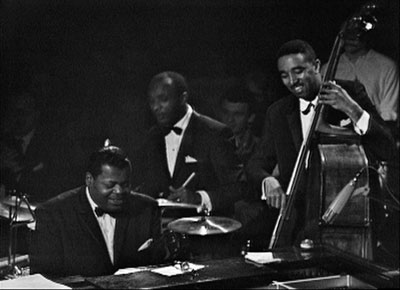
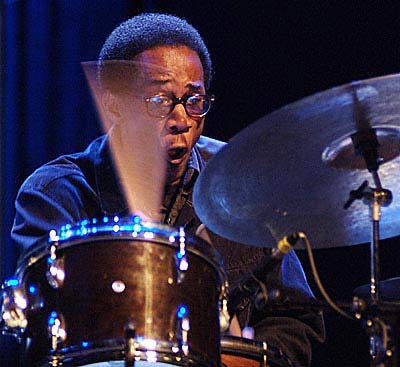
Here's some more rare footage of drummer Ed Thigpen, courtesy of the kind folks over at Drummerworld (www.drummerworld.com) presenting a masterclass at New York's Drummer's Collectve circa. 1982.
He will be missed.
Some interesting connections I made while watching these clips:
If you listen carefully in the second clip, you'll hear Thigpen singing along to his brushwork. I recognize that tune as being the spiritual "David Danced Before the Lord" - the same piece arranged by Duke Ellington that featured drummer Louie Bellson and tap dancer Dr. Bunny Briggs in one of his Liturgical Concerts.
Here's the link to my previous post where I discussed that:
Hearing this also reminded me of an Ed Thigpen brush clinic I attended in Montreal around 1996. When demonstrating his graceful brush patterns he uses for ballad tempos, Thigpen sang the lyrics and melody to the jazz standard "What's New". Again, as I posted last week, I think there is a connection between knowing the lyrics of a song and the rhythms we play.
Obviously Ed Thigpen had this figured out a long time ago !
Some rare concert footage today of one of my favorite hard bop jazz drummers, "Philly Joe Jones", shown here with pianist Thelonious Monk and saxophonist Charlie Rouse from a 1969 date in France.
There is not a lot of footage out there of "Philly" playing the drums, so I relish any opportunity to catch the master in action. I'm also always impressed with the elegant motion he plays with and the huge sound he gets out of the drums. Jones was also a devout student of the Charlie Wilcoxin snare method "Rudimental Swing Solos for the Modern Drummer" and a lot of that snare drum vocabulary shows up in his playing.
Here's the drum solo portion of that last tune, "Nutty", isolated: (for all the drum geeks out there !)
Several CD's arrived in my mailbox last week so lots of fresh listening to do these days. One album that I've been looking forward to receiving and working with is entitled "Ritimista: World Percussion Play-along Series, Vol. 1".
Produced by percussionist Mark Powers, this CD provides 11 different percussion grooves, each at two tempos (slow & fast) to practice with. The grooves include common Afro-Cuban patterns such as the 6/8 Tumbao, Rumba Guaguanco, Cascara, 3-2 Son Clave and 3-2 Rumba Clave as well as several popular West African patterns.
The recording quality is excellent and the grooves are solid, making it an excellent resource to practice with any Afro-Cuban or West African rhythms, either on drum set or hand percussion.
I've been working out of Billy Martin's remarkable book entitled "Riddim" and I look forward to using this new CD to practice Martin's coordination patterns along with. I find it can be a bit more interesting to play these rhythms within a specific stylistic context so Ritimista definitely will help.
One can find out more about this great resource and order it here:
http://www.powerspercussion.com/products.htm
Speaking of play-along CD's to practice along with, I would also highly recommend this fantastic CD:
When I studied with Terry Clarke two years ago, during my first lesson he handed me a copy of this CD (which he had gotten from Jim Blackley) and my assignment for the year was clear - play along with this entire CD perfectly from start to finish. Well this proved to be quite a task considering that the 18 tracks ranged in tempos from 40 to 340 beats per minute !!!
Produced by British drummer Allan Cox, this CD features a bassist and guitarist playing blues and rhythm changes at tempos ranging from very slow to very fast with everything in between - and the execution, precision and recording quality is dead one making this another great resource to play along with.
You can order this gem directly from Allan's website here:
I'm spending the weekend getting my life in order before attending a Jazz @ Lincoln Center Jazz Educator's Workshop next week and then off to the Banff Centre for the Arts for four weeks up until the end of February. More on these exciting upcoming experiences later. Busy times !
Anyhow, here's one of the great bass & drum pairings in jazz music, Charles Mingus and Dannie Richmond, trading back and forth - and then Mingus himself briefly explaining to an interviewer what he's thinking about when doing so (!)
And by that, I mean "scare me" in a good way !!! Every once in a while I hear a drummer who plays so well that I'm completely baffled by their unique rhythmic sophistication & language that they've created on the drums. It's so overwhelming yet so inspiring and motivating at the same time.
A few contemporary drummers (for me) that fall into that category would include:
Dan Weiss, John Hollenbeck, Dafnis Prieto (whom I'm studying with later this month at the Banff Centre), Kendrick Scott, Gene Lake, Eric Harland, Tyshawn Sorey and, the subject of today's post, Mark Guiliani (and of course there are many others too !)
I first heard drummer Mark Guiliani with bassist Avishai Cohen's trio at the Rochester International Jazz Festival in 2003. I was playing there all week with Montreal jazz musicians Jennifer Bell, Dave Mossing and Dave Watts so I got to check a lot of heavy jazz musicians during my time in the city. Most of these musicians travelled up from New York City to perform in Rochester that week. The evening jam sessions, hosted every night in the hotel bar, were also a highlight.
Anyways, this guy is just playing great and he's really young so I'm sure we'll be hearing more of him in the future. Check him out here with bassist Avishai Cohen:
Here with pianist Jason Lindner and the "other" Avishai Cohen (trumpet):
And a few other brilliant shots of Mark in action:
Ridiculous !
Speaking of young, contemporary jazz drummers that scare me....last year, Ben Ratliff of the New York Times ran an article entitled "Five Drummers Whose Time Is Now" that featured several dynamic young jazz drummers currently making waves in New York City.
Find that interesting read here:
"Five Drummers Whose Time Is Now" - by Ben Ratliff - New York Times
Someone, who had the best seat in the house at Birdland the other day (!), was kind enough to capture Jack DeJohnette in his element and post his creation on youtube. Lucky for us !
I've been on a huge DeJohnette kick lately after having seen him at the 2009 PASIC convention in Indianapolis. I have also been checking out this great album, a 70s ECM release entitled "Pictures". This is essentially an album of Jack playing solo drum compositions (with help from John Abercrombie & a track featuring Jack on solo piano):
This one is a must have for any Jack fans out there !
It's with great sadness that I have just heard and now report that the great master drummer Ed Thigpen passed away today in Copenhagen at the age of 79 after a lengthy illness.
Thigpen, who was aptly nicknamed "Mr. Taste", is probably best remembered as the drummer with the Oscar Peterson Trio (along with Ray Brown on bass), as a sideman to so many jazz greats and as a leader of his own various ensembles. (Check out his album as a leader "Out of The Storm")
My first introduction to "Mr. Taste" came when I was a teenager having heard the Oscar Peterson albums "Night Train" and "The Canadiana Suite". His swinging groove and tasteful dynamics made a great impression on me as he was one of the first serious jazz drummers I ever heard and checked out.
My father also purchased a copy of Canadian jazz pianist Oliver Jones' 1991 album "A Class Act" following his performance at the Regina Jazz Society with bassist Dave Young. This disc got a lot of airplay in our household for weeks afterwards. One track that stood out for me was "Stan Pat", a calypso written for Montreal pianist Stan Patrick and featured an extended drum solo for Thigpen using a plethora of Caribbean rhythms. My father is still asking me when I'm going to play that tune !
Thigpen's brushwork also impressed me and I promptly purchased his book entitled "The Sound of Brushes". This became an important part in learning my brush technique and installed a sense of appreciation and awe for the art of brushes that continues to this day (see some of my previous posts for proof of that !)
Shortly afterwards purchasing this great book, I met Ed Thigpen in person at the Remo drum booth in the convention hall at the 1995 IAJE convention in Anaheim, California. I remember thanking him for writing such a great book and he was nice enough to give me a short brush "lesson" after I told him I couldn't figure one of his uptempo brush patterns.
Well, he made it look easy and I'm still trying to figure that one out !
Here's a shot of Thigpen featured with Billy Taylor from 1958 on a superb drum feature entitled "Titoro". Dig not only his intense rhythmic approach but the variety of creative sounds he gets out of such a small collection of drums and cymbals:
Inspiring stuff ! I also appreciate the profound influence of Papa Jo Jones in that clip - one of Thigpen's early influences.
And here's Ed Thigpen in his element, swinging with Oscar Peterson & Ray Brown - the classic trio - from a live concert in Italy (and later with special guests Herb Ellis and Roy Eldrige sitting in):
And finally, a swinging performance of Oscar Peterson's "Reunion Blues" from a television date in London circa. 1964:
I think this is a fitting tune to finish this post as I'm sure Ed is now in heaven, reunited with his old friends Oscar and Ray, no doubt sharing some laughs and great music while sitting in the big jam session in the sky...
I've been fortunate to have worked with many great jazz vocalists over the years including such artists as Pat Steele, Carol Welsman, Karen Plato, Dionne Taylor, Carmen Lundy, Sienna Dahlen, John LaBelle, Kristin Korb, Louise Rose, Trish Colter and an amazing extended engagement with Montreal's Johanne Desforges. All great musicians !
As a drummer, playing with a vocalist requires a special mindset and sensitivity. These are all important skills to master as a drummer and I always look forward to the opportunity to work with a good singer. This week, while working with some vocal jazz students at a local high school as an accompanist, I was reminded of this and put some thought into the importance of learning the lyrics to the tunes I'm playing. While playing with these talented young students, I purposely quietly sang/mumbled the lyrics to myself while accompanying the students as a personal exercise (I had the lead sheets with the lyrics written on them right in front of me on a music stand!) I sure noticed a new and fresh dimension to these standards that I've played so many times.
Understanding the lyrical aspect of these Jazz standards we play so much is one often overlooked, and not just by drummers - but my most jazz instrumentalists, I think. I believe that as drummers (and overall as jazz musicians), we have to have as many tools as possible at our disposal regarding the piece of music we are playing if we really want to play it properly and explore it throughly. I think that by learning the lyrics to a melody, it would undoubtedly have a positive effect on one's melodic phrasing.
Apparently drummer Art Taylor was renowned for knowing all the lyrics to all of the standards he was playing, as did his frequent employer, tenor saxophonist Dexter Gordon. So perhaps there is something to be said for knowing the words to the songs we are playing ? It's an interesting argument worth exploring.
Anyways, some of my favorite jazz singers include Ella Fitzgerald, Sara Vaughn, Nancy Wilson, Joe Williams, Tony Bennett, Frank Sinatra, Abbey Lincoln and, of course, Billie Holiday.
Here is a favorite clip of mine of Billie Holiday with an all-star band from the 1957 CBS television special "The Sound of Jazz" on the composition "Fine and Mellow":
Apparently the musical dialogue between Holiday and Lester Young here was a special moment as they had not been on speaking terms for some time and were avoiding each other that day. This particular piece represents the last time these two artists would perform together.
As producer Nat Hentoff remembers:
"Lester got up, and he played the purest blues I have ever heard, and [he and Holiday] were looking at each other, their eyes were sort of interlocked, and she was sort of nodding and half–smiling. It was as if they were both remembering what had been—whatever that was. And in the control room we were all crying. When the show was over, they went their separate ways. "
Sadly, both Billie Holiday and Lester Young both passed away within two years of this epic recording.
Some brilliant footage today forwarded to me by Regina jazz bassist & visionary Carlo Petrovitch.
Here's the Oscar Peterson Trio with drummer Ed Thigpen (showing NO mercy on the drums!) and Ray Brown bass, all featured on Ray Bryant's latin jazz classic "Cubano Chant":
Carlo explicitly told me to mention the ENORMOUS bass that Ray Brown is playing in that clip !
While browsing other Oscar Peterson clips on youtube.com I came across another Peterson favorite of mine, originally introduced to me by another Regina jazz musician, Jim Gallagher.
Here's another incarnation of the Oscar Peterson Trio performing "Blues Etude":
There's more than a few lessons in there !
The Oscar Peterson Trio (with Ed Thigpen on drums) was one of my first formative influences while I was checking out jazz music during my teens. In my high school library, the music section (one small shelf!) contained only three jazz records, but all of which still influence me to this day:
Oscar Peterson - "Night Train" w/Ed Thigpen on drums
I decided today to highlight another favorite drummer of mine, but one who gets little attention in jazz circles - that being the great Frankie Dunlop who held the drum chair with Thelonious Monk's quartet during the 1960s (Ben Riley was another significant drummer who played with Monk around this time). Frankie Dunlop is, somewhat, so obscure that I couldn't even find a photo of him to post on my blog ! (so I settled for the cover of one of my favorite Monk albums he plays on). I was first introduced to Dunlop's brilliant and unique drumming style by now Paris-based jazz drummer Karl Januska. Karl and I went to McGill together during the mid-1990s and I've been a big fan of Dunlop's bouncy, medium tempos ever since. When I studied with drummer/pianist Andre White while pursuing my Master's Degree at McGill, studying Dunlop's approach to soloing and comping were both serious assignments he gave to me - and I sure learned a lot from those !
Frankie Dunlop is a great drummer that we should pay attention to and study. His approach to rhythm was a great compliment to Thelonious Monk's and, while steeped in the bop tradition of drumming, he definitely had his own thing going on. Pay attention to his solos and notice how he will intentionally turn the beat around and play the hi-hat on beats 1 & 3 - and it swings like mad !
*Also interesting to note: I once read in a Jazz Times magazine interview with drummer Jeff "Tain" Watts where he stated that Dunlop was a big influence on him as well. Maybe not such an obvious influence since the influence of Elvin and Tony play such a predominant role in Watt's drumming style. But it's in there !
Anyways, here's a few rare clips of Frankie Dunlop featured with Thelonious Monk:
And here's a clip of Ireland's premier jazz drummer, Conor Guilfoyle, demonstrating his transcription of Frankie Dunlop's solo on the Monk composition "I Mean You":
Conor has a wealth of great drum lessons on youtube.com and check out his website for other great lessons and more transcriptions and such:
Today, from some concert footage originally aired in the UK comes a drum battle of epic proportions.
Here Elvin Jones, Max Roach and Art Blakey take the stage in one of the heaviest displays of cooperative jazz drumming I've ever seen:
I don't know about you, but if I was ever playing the drums and had Elvin Jones looking over my shoulder, I might be just a tad intimidated ! Just sayin'...
More great footage today of the master rhythmatist & sound sculptor Matt Wilson in action. This time in a variety of improvised solo spots filmed by director Daniel K Berman for a television series entitled Solos: The Jazz Sessions, produced for the Bravo! channel on Canadian television.
There are several GREAT episodes in the series, all featuring many of the world's leading jazz artists, all performing in an improvised SOLO setting. This was a great idea ! Make a master jazz musician comfortable in a nice setting, let him/her do there thing and film it. Brilliant.
You can also find out more about this great series and even order DVDs from the website here:
www.solosjazz.com
Check out all the heavyweights that contributed to this series !
The Matt Wilson episode is great but I also recently acquired the Matt Wilson/Lee Konitz duet DVD from the same series as well and that is really something else. Matt and Lee have a musical relationship going back several years and it shows. I've also enjoyed their duologue on this particular album:
Incidentally, all the features for the Solo sessions were filmed at the Berkeley Church & Performance space in Toronto, where I played my first gig in Toronto after moving there in 2007. Of course, the music we were playing for the wedding reception taking place in the Berkeley wasn't nearly as hip as these sessions !
Kendrick Scott is a great young drummer who is making waves in Jazz circles these days. I first heard Kendrick in Washington D.C. while playing with vocalist Julie Hardy in 2003. She gave me a CD of her music to learn for our gig and after some listening (like after the first 8 bars!) I was like: "Who the hell is this amazing drummer ???" Of course, it was her friend Kendrick Scott whom she and her husband/pianist Randy Ingram had gone to school with and played with during their days in Boston. I was immediately a fan.
Lucky for me I heard Kendrick play later that week and met him backstage at a gig of his in Washington D.C., at the Kennedy Center for the Performing Arts, where he was playing with Terence Blanchard's band. Kendrick is the regular drummer in Blanchard's band and is really playing great these days.
To me, Scott is a perfect example of a great contemporary jazz drummer who has all the tools necessary to play Jazz music effectively in today's crazy world: great technique, swings hard, grooves hard, nice touch & feel on the drums, impeccable musicality and he is able to switch stylistic gears and combine musical styles effectively without sounding cliched.
Here's Kendrick in a couple of solos spots with non other than Herbie Hancock:
Nice gig to have !
And here's a couple of clips of Scott performing with tenor saxophonist Jimmy Greene:
And some more nice footage of Kendrick Scott playing with his current employer, Terence Blanchard:
Kendrick Scott also has a couple of albums released under his own name and I would highly recommend these to anyone interested in checking out this fine contemporary jazz drummer.
For those not aware of this great series presented by the CBC's Sunday Edition radio program, I would highly recommend checking this out. The program is hosted by Michael Enright with music expert Richard Harris. Each program highlights a specific piece of music and they discuss the cultural impact that each piece of music had during its time. Lots of great history there and I guarantee that you'll learn something.
Fortunately this is all available online and I believe that a CD boxset will soon be available.
Check it out on the CBC's Sunday Edition website here:
Some more important brush patterns posted here today, here explained by Vater drumstick artist James "Animal" Harrison.
The brushes are still a misunderstood aspect of drumming and I'm always encouraging younger students to learn how to play them and explore the textural opportunities they afford. They really are a different animal than a pair of sticks so we, as drummers, really have to pay attention to them and practice them as such. Fortunately, with such great instructional books and DVDs that are available on the market today and dedicated specifically to the art of brushwork, there is really no excuse not to check them out !
More nice concert footage today from Europe, this time from 2006 with Jack DeJohnette on drums, John Scofield on guitar and Larry Goldings on organ and keyboards (what, no Hans Groiner ?)
Trio Beyond was formed as a tribute band in 2003, paying homage to the Tony Williams Lifetime group of the 1970s.
I've been in the middle of several interesting e.mail exchanges lately with my DMA colleagues Tom Van Seters & Patrick Boyle and future U of T jazz professor emeritus Paul Read about the role and validity of using a metronome in one's practice routine. I was also intrigued by a couple of other posts that have popped up on my jazz blog radar regarding the use of a metronome (or not!)
Check out some interesting discussion at Dave Douglas' blog here where he answers some questions originally put forth by bassist Jeff Berlin on the topic of using a metronome:
"about the time that someone gave Oscar Peterson a drum machine to play with. After a week of fooling around with it, Peterson reported back, “This is fun, but it drags.”
HA !!!
Interesting. I obviously can't really deny that Peterson swings like MAD so who cares if he speeds up and couldn't match the click. What does this tell us about playing with a metronome ?
I am very interested in the Metronome Debate and in different musicians opinions that exist in regards to whether or not practicing to a metronome really benefits his or her Time and/or Time Feel.
*I'll begin by stating that I don't think these two elements, Time & Time Feel, are necessarily one and the same !*
(more on that later)
Some musicians feel that playing with a metronome doesn't really help you at all (see Jeff Berlin's letter to Dave Douglas) yet
others think that it's an invaluable tool to developing your sense of Time. I always relish at the opportunity to sit down with Montreal trumpeter and McGill professor Kevin Dean to hear about his philosophy regarding Time and how he uses a metronome in practice. After you listen to him preach, you'd swear there was no other way !
One thing is for sure though, GREAT musicians consider having great Time a priority (almost to the point of being like a religion) and not something to be taken lightly.
However, how the metronome plays into that equation is still up to debate.
So here are some questions I'd like to address in this blog over the course of the next while and I would certainly appreciate any feedback from anyone out there who is reading this and cares : )
- Are metronomes useful tools for developing ones' sense of time ?
- Why or why not ?
- If Yes, what different ways can you use a metronome to practice ?
- If No, what tools or approach do you use instead to develop your sense of Time ?
Happy New Year everyone and I hope you all have a great 2010 ! Welcome back to Four on The Floor and I'm looking forward to another year of posts relating to jazz drumming and other things (like my favorite recipes, among other things...). Thank you for your continued support.
Over the holidays I've had some nice down time and the opportunity to check out some new music and grab lots of great things off the web. These days I'm a big fan of the live streaming video feed from Small's Jazz Club in New York City.
Follow this link: http://www.smallsjazzclub.com/index.cfm?itemCategory=32338&siteid=272&priorId=0&banner=a
I check in often and we are lucky to have this great web resource. I'm often amazed at the number of great artists that I'm introduced to via this site aside from the other jazz greats that I get to listen to in real time if I can stay up late enough. They also have a number of shows audio archived for later listening.
One gig I caught not too long ago that caught my attetion featured vibraphonist Mark Sherman with drummer Tim Horner, two great musicians I was not familiar with. I sat up quite late that evening (they were playing the late set !) and enjoyed their set immensely.
Here's some footage of both Mark and Tim in action from a previous gig at the Sweet Rhythm jazz club in New York City, with Joe Magnarelli on trumpet:
This is a blog about jazz, jazz drumming and all things unrelated. Thanks for stopping by!
A Bit About Me...
Jonathan McCaslin was born in Winnipeg, Manitoba and raised in Regina, Saskatchewan. Jonathan began playing the drums at the age of nine. He progressed through the Regina Lions Junior Band and the music program at his high school, Campbell Collegiate, soon developing a passion for playing the drums and jazz. Ultimately, Jon's interest in music led him to enroll in the Jazz Studies program at McGill University, graduating with distinction in 1999.
While at McGill Jon had the opportunity to study with some of the finest jazz educators in the country including Gordon Foote, Kevin Dean, Jan Jarcyzk, Chris McCann, Andre White, Michel Lambert and Dave Laing. He also attended the prestigious summer jazz workshop presented by the Banff Centre for the Arts in 1997, where he performed with Canadian jazz greats Hugh Fraser, Don Thompson and Kenny Wheeler.
Jon has also been fortunate to have performed with many of Canada's jazz elite including Charlie Biddle, Brian Hurley, Louise Rose, Alaister Kay, Mart Kinny, Gary Guthman, Mike Rud, Hadley Caliman, Greg Clayton, Chase Sanborn, Andre White, Tilden Webb, John LaBelle, Kevin Dean, Dave Turner, Ralph Bowen, Don Thompson, Dionne Taylor, Jim Vivian, Kelly Jefferson, Ian McDougall, Brad Turner, Jim Brenan, The McGill Jazz Orchestra, Jeff Johnston, Lorraine Desmerais, Steve Amirault, Hugh Fraser, Chucho Valdes, Kieran Overs, The Altsys Jazz Orchestra, Pat LaBarbera, The Regina Symphony Orchestra and The Montreal Jazz Big Band.
In the spring of 2002 McCaslin completed his Master's in Jazz Studies at McGill University where he studied jazz drumming, improvisation and composition.
In January 2003 Jon released his debut CD, “McCallum’s Island”. Featuring his quintet, the CD contains an exciting collection of McCaslin’s original compositions, featuring himself and his band. The release of this CD was followed by a twenty-day tour of Western Canada, performing to enthusiastic, capacity audiences. During March of 2003 Jonathan was the recipient of a fellowship from the Kennedy Center for the Performing Arts and attended the “Betty Carter Jazz Ahead” residency in Washington, D.C. Along with twenty other distinguished young jazz artists, McCaslin was featured with such jazz icons as Terence Blanchard, Carmen Lundy, Winard Harper, Curtis Fuller and John Clayton.
McCaslin’s quintet performed at the 2003 edition of the Montreal International Jazz Festival and was nominated for the General Motors Grand Prix du Festival (awarded to the most outstanding Canadian group). From 2004 until 2006, Jon toured North America, Asia and Europe with the high-energy, critically acclaimed music production troupe “Barrage”. Featuring a cast of seven world-class fiddlers and a four-piece band, this dynamic show featured high-energy music and fiddle traditions from around the world set to upbeat choreography and movement.
In 2015, Dr. McCaslin received his Doctorate through the University of Toronto and completed his dissertation on the conceptualization of contemporary melodic jazz drumming. He is currently based in Calgary, Alberta where he maintains a busy performing and teaching schedule across Canada.