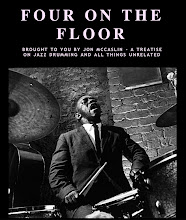
WELCOME TO FOUR ON THE FOUR: A BLOG ABOUT JAZZ DRUMMING AND ALL THINGS UNRELATED, BROUGHT TO YOU BY JON McCASLIN

Friday, September 18, 2009

Caravan Drum Patterns

My good friend and music educator Nick Fanner asked me about which drum patterns I like to use when playing the Duke Ellington/Juan Tizol tune "Caravan" and that I would recommend teaching to beginner/intermediate jazz drummers.

There have been many versions and approaches to this piece over the years, but here are some very basic patterns and a couple of variations which are relatively easy to learn and sound/feel reasonably authentic.


These patterns were all inspired from drummers I've heard over the years such as Art Blakey, John Riley, Stanton Moore, Shannon Powell and Peter Erskine.

Of course you can experiment with the left hand playing different combinations of drums and crosstick patterns among other variations.

There are also more specific foot patterns for these kind of grooves, but if you don't over emphasize the quarter note bass drum/hi-hat patterns that I've written out, they work fine.

Maybe not so authentic, but they work !

Wednesday, September 16, 2009

Wynton Marsalis & The Jazz @ Lincoln Center Orchestra


Last night took me to the Banff Centre for the Arts where I attended a concert featuring Wynton Marsalis and the Jazz at Lincoln Center Orchestra. Having heard them in both Montreal and Toronto, this is the third time I've seen this group and it was definitely the best performance I've seen of them yet.

Performing to a capacity crowd, the orchestra played pieces drawn mostly from the classic "Blue Note" era (i.e. pieces by Jackie McLean, Joe Henderson, Thelonius Monk, Lou Donaldson) with all the arrangements penned by members of the orchestra itself.

Last year in Toronto I was a little disappointed with the arranging in that the focus was heavily more focused on the soloists rather than the ensemble. However, last night the balance seemed more even and featured not only great soloists but tight ensemble playing and more extensive writing.

A few notable things that stood out:

- McGill alumni Paul Nedzela filling in for Joe Temperly on Baritone Saxophone. Way to go Paul !

- James Zollar, whom I remembered from my days in New York following around the Matt Wilson "Educational" Quartet, was astounding on his muted trumpet feature on Duke Ellington's "Portrait of Mahalia Jackson" (from Ellingtons "New Orleans Suite")

- Ted Nash's tongue-in-cheek arrangement of "Old MacDonald Had a Farm"

- Wynton's own arrangement of Thelonious Monk's "Ugly Beauty" was a crafty feature for the saxophone section

- The rhythm section was rock solid and of course drummer Ali Jackson Jr. - you are my hero !

I should also take this opportunity to say what a delight it was to hear the band so perfectly sound-wise. The sound engineers did a fantastic job of managing the sound. In my experience this is very rare. Most of the time, sound engineers don't have a clue what they are doing when it comes to jazz music. But the crew at the Banff Centre did an excellent job of amplifying what was needed without the need to over amplify anything or replace the acoustics of the band with unneeded micing.

Well done !


Ali Jackson Jr. - Swingin' !

Sunday, September 13, 2009

M'Boom


Toronto jazz pianist and Star Trek aficionado Gerry Shatford sent me this great link that has some footage of the jazz percussion ensemble M'Boom.

It's a television spot from a little known music variety show called SOUL! in which the program featured predominately African-American performers.

Here's the link to the footage:

http://www.thirteen.org/soul/2009/02/04/nov-17-1971/

Sorry - I wasn't able to embed this one...


Max Roach founded this innovative percussion ensemble in 1970 as a means to combine traditional concert percussion instruments with world percussion and a distinct "jazz" sensibility.

I purchased the M'Boom album "M'Boom: Live at S.O.B.'s" when I was a teenager and not only dug their unique approach but also the tympani players soloing on "Blue Monk" and the musician who played musical Saw (!)


For more music from this amazing ensemble, check this out:

http://fattoro.blogspot.com/2009/08/mboom-repercussion-strata-east-1973.html#comments

Tuesday, September 8, 2009

Table Tennis = The Secret to Jazz ?


Hmmmm.....


Don't forget that Wayne Shorter wrote a tune called "PING PONG" on this album:


And if you feel the need to catch New York's finest jazz talent while playing a game of table tennis or another type of parlour game, don't forget this joint:


http://www.fatcatmusic.org/gaming.html

I could be on to something here...

Desiderata

"Go placidly amid the noise and the haste, and remember what peace there may be in silence.

As far as possible, without surrender, be on good terms with all persons. Speak your truth quietly and clearly; and listen to others, even to the dull and the ignorant; they too have their story. Avoid loud and aggressive persons; they are vexatious to the spirit.

If you compare yourself with others, you may become vain or bitter, for always there will be greater and lesser persons than yourself. Enjoy your achievements as well as your plans. Keep interested in your own career, however humble; it is a real possession in the changing fortunes of time.

Exercise caution in your business affairs, for the world is full of trickery. But let this not blind you to what virtue there is; many persons strive for high ideals, and everywhere life is full of heroism.

Be yourself. Especially do not feign affection. Neither be cynical about love, for in the face of all aridity and disenchantment, it is as perennial as the grass.

Take kindly the counsel of the years, gracefully surrendering the things of youth. Nurture strength of spirit to shield you in sudden misfortune. But do not distress your self with dark imaginings. Many fears are born of fatigue and loneliness.

Beyond a wholesome discipline, be gentle with yourself. You are a child of the universe no less than the trees and the stars; you have a right to be here. And whether or not it is clear to you, no doubt the universe is unfolding as it should.

Therefore be at peace with God, whatever you conceive Him to be. 
And whatever your labors and aspirations, in the noisy confusion of life, keep peace in your soul.

With all its sham, drudgery, and broken dreams, it is still a beautiful world.

Be cheerful. Strive to be happy."

- Found in St. Pauls Church, Baltimore 1692


Friday, September 4, 2009

Learn Your Rudiments !


During some research I conducted for one of my DMA Jazz pedagogy seminars last year at the University of Toronto, I came across a disturbing article entitled "The Anti-Rudiment Man". I won't reprint the article or call out the author by name here, but I was angered that this supposed "professional" jazz drummer (who clearly isn't) decided to focus on downplaying the importance of drummers learning the basic snare drum rudiments and the role that these patterns have played in developing the language of jazz drumming.

You would never tell a pianist or horn player to abandon the study of scales and learning the rudiments for a drummer, no matter what style, is no different. The rudiments, like scales for a horn player, are the building blocks which everything we play as drummers are based. It's up to a drummer to apply them in a musical fashion, but none-the-less you can't ignore them. And all the great jazz drummers - from Baby Dodds, Chick Webb, Papa Jo Jones, Max Roach, Kenny Clarke to Elvin Jones, Tony Williams, Jack DeJohnette, etc. have all studied and used the rudiments in their playing in some capacity.

So having said this and for your reference, here are the standard 40 PAS (Percussive Arts Society) Rudiments:

http://www.pas.org/Resources/rudiments/rudiments.html

And here they are organized thanks to the kind folks at Vic Firth. By the way, I've been enjoying your latest line of pepper shakers Mr. Firth !


www.vicfirthgourmet.com

Ahhhh yes, enjoy freshly ground pepper on your meal while practicing these patterns:

http://www.vicfirth.com/education/rudiments.html

Additionally, the legendary Boston teacher Alan Dawson (who taught Tony Williams among dozens of other world-class drummers) arranged the rudiments and some variations into a sort of drum set "etude" he liked to call the Rudimental Ritual.

Dawson had his students practice the "Ritual" with a samba bass drum and hihat pattern. Once his students mastered the routine with sticks, he would also have them play it through with brushes. Takes awhile. Trust me...

Here it is for your reference:

http://rudimentalritual.tripod.com/

Check out the audio files on this site of Dawson demonstrating his creation.

If the rudiments were good enough for Alan Dawson and Tony Williams - I'm sure the rest of us can work on them !

Thursday, September 3, 2009

Tyshawn Sorey on playing "Free" music...


Up-and-coming New York jazz drummer and composer Tyshawn Sorey was recently interviewed in Modern Drummer magazine. Tyshawn is a musical force and everyone in jazz circles will soon be talking about him (if they aren't already!).

I thought I would include a portion of his interview which I found particularly inspiring. In this day of jazz-related dialogue, argument and commentary in regards to playing "free" vs. "straight-ahead", etc. I think that Sorey puts things in a very thoughtful perspective.

MD: What's your approach to free music ?

Tyshawn: Well, I like to believe that I play free all the time. [laughs] In other words, I don't consider myself an avant-gardist, jazz purist, or any kind of stylist. I guess I'd call myself a traditionalist - not in the way we think of what a traditionalist is, but there is a tradition in all of the great masters we study that makes them great masters. I mean, they were "free" players also - free in the way they expressed themselves whenever, with whomever. Freedom for me is having enough resources in your drumming that you can do anything you want to do, coupled with discipline and the willingness to bring the best out of the other musicians you play with. Listen to Louis Armstrong recordings, and then to the stuff that Kenny Clarke and Max Roach did with Charlie Parker, the Beatles, Jimi Hendrix, James Brown - I mean, to me that shit is just as free as what we call avant-garde. I don't think there is any qualitative difference there, in terms of how free they play themselves. So I would like to think I can have this kind of freedom, where I can be as creative as I can be and be able to play with anybody, in any style. And it comes from within yourself, and from discipline. It's like what Elvin Jones once said: "If you don't know what discipline is, then you don't know freedom either."

[from "Tyshawn Sorey", story by IIya Stemkovsky, Modern Drummer - September 2009]

That's deep !

Here's a great clip of Tyshawn being interviewed at Drummer World in New York and him talking about his role as a drummer/composer:

Saturday, August 29, 2009

Happy Birthday Charlie Parker


Charlie Parker - my all time favorite jazz artist - would have been 89 years old today.

Happy Birthday Bird !

Here's an excellent article from jazz.com that features alto saxophonist Steve Coleman talking about the genius of Charlie Parker's music. Props to Peter Hum at the Ottawa Citizen for finding this one.

http://www.jazz.com/dozens/the-dozens-steve-coleman-on-charlie-parker

Here's one of the few video clips of Parker playing with Dizzy Gillespie. Dig the left-handed drummer Charlie Smith swingin' away on one of my favorite bebop tunes "Hot House".


BIRD LIVES !!!

Thursday, August 27, 2009

Louis Hayes


This morning someone forwarded me this clip of the great Louis Hayes as featured with the Cannonball Adderly Quintet on the tune "Bohemia After Dark".

Hayes has always been a favorite of mine. I recall a trio date he did with McCoy Tyner that was given to me by my jazz combo teacher Brenda McAlpine many, many years ago when I was growing up in Regina. I can't remember the name of that particular album (!) but I'll have to try and dig that one up.

Louis Hayes is still around, performing and playing great. I hope to catch him sometime in the future. Many drummers don't realize that his driving and propulsive swing had a huge influence on Tony Williams.

This clip is a nice feature for Hayes with a classic group.

Wednesday, August 26, 2009

Max Roach w/Milt Jackson and the Jazztet

Stumbled across this nice surprise:

My heroes Max Roach, Milt Jackson and Toots Thielemans sitting in with Benny Golson, Art Farmer and the Jazztet !!!

Friday, August 21, 2009

Jack DeJohnette

Some nice drumming from Jack DeJohnette with his "Special Edition" band circa. 1983

Thursday, August 20, 2009

Ignacio Berroa - Afro Cuban Drumming


Ignacio Berroa is a fantastic Cuban jazz drummer who has toured the world with such jazz artists as Dizzy Gillespie, Charlie Haden, Tito Puente, Gonzalo Rubancaba and his own jazz/fusion group as a leader.

Not only do I really dig his approach to playing Afro-Cuban rhythms on the drum set, he also swings like mad ! It's impressive and inspiring to see a drummer from another culture play jazz so convincingly. Jazz music really is a music of the world.

Montreal bassist Brian Hurley once told me that he was hosting the after hours jam session at the Ottawa Jazz Festival when Ignacio came to sit in. Hurley suggested to Berroa that they play a set of latin tunes. "No man - let's swing !" exclaimed Ignacio and according to Hurley, they certainly did !

His modern approach to latin jazz drumming can be boiled down to this:

Tony Williams/Elvin Jones/Roy Haynes + Clave + Rhumba = Ignacio Berroa

In these clips Ignacio goes through some basic Afro-Cuban rhythms and demonstrates how to apply them to the drum set.
Joining Berroa are the legendary Giovanni Hidalgo, Changuito and Michael Spiro with David Sanchez and Danilo Perez.

Wednesday, August 19, 2009

Drums Patterns 2.0

Here are a couple of patterns I've been messing around with lately on the drums. They sound sort of Tony Williams/Jack DeJohnette/Cindy Blackman'ish when you play them fast enough.

They are based on this basic rudiment that I like to play that has no name (!) that looks sort of like this:

rLLLR rLLLR rLLLR rLLLR

*This pattern is grouped in groupings of 4 eighth-notes. The first 'r' is a grace note (i.e. a left hand flam)

I suppose it's sort of an extended variation of a Swiss Army Triplet that starts on the Left hand.

Anyways, here's the drum set variation:


And here is a variation using a 3-beat cycle:


They are tricky patterns because you introduce a double stroke on the right hand that is split between the cymbal and the snare drum.

Some nifty variations would include adding the hi-hat on four quarter notes or eighth notes to give that Tony Williams vibe.

You can also add a bass drum note to the beginning of each pattern so you get a sort of Brazilian/Samba-like vibe going.

(i.e. ba-boom, ba-boom, ba-boom, etc.)

Here is what they would look like with the added bass drum variaton:


And with the 3-beat variation:


Enjoy !

Tuesday, August 18, 2009

Steve Lacy - Lift The Bandstand


Steve Lacy was a great soprano saxophonist who covered a wide range of creative territory as a jazz artist. He was also apparently a huge influence on the soprano playing of John Coltrane. Lacy started his career playing soprano sax during the Dixieland Revival of the late 40s and early 50s, only to skip playing bebop, and collaborate with such avantgarde musicians such as Cecil Taylor and Denis Charles. He also had a very close relationship with Thelonious Monk and would continue to perform Monk's music until his death.

I was fortunate to hear Lacy play and speak at a clinic at McGill University in 2004, not long before his death. At this clinic, which I remember was not very well attended(!), he played some brief solo soprano saxophone solos and talked, at length, about his life and career as a creative musician and artist. It was, as I remember it, one of the most profound musical experiences of my life. Hearing the music and wisdom of a master, in person, was pretty inspriring stuff.

If you are interested, one should check out Derek Bailey's book entitled "Improvisation" and the book "Steve Lacy: Conversations" by Jason Weiss. I've always particularly enjoyed Lacy's way of articulating the creative process and his take on what it means to be a jazz musician.

I came across this documentary/interview/performance of Lacy and I think it gives great insight into the mind of one of jazz music's creative geniuses. Check it out:


Some nice footage of the Steve Lacy band in San Francisco. Dig the introduction featuring John Betsch on drums:


Here are some notes from Steve Lacy about the lessons he learned while playing with Thelonious Monk. Sound advice !


Now - LET'S LIFT THE BANDSTAND !!!

Monday, August 17, 2009

When It's Haynes....It Roars !

From the classic Stan Getz quartet featuring Roy Haynes, Gary Burton and Steve Swallow.

Sunday, August 16, 2009

Rashied Ali and Jaco Pastorious


With the recent passing of the legendary free jazz drummer Rashied Ali this week, I was browsing youtube for clips of this master drummer.

And I came across these audio clips of Rashied Ali playing duets (for the most part) with bassist Jaco Pastorious. Wow, didn't see this coming...I thought this was, not only unexpected, but very inspiring.

Not exactly the most obvious or expected pairing of musicians - but it works. Enjoy !


Saturday, August 15, 2009

Mel Lewis

Here's a great clip featuring Mel Lewis to get the weekend off to a good start...


Very nice and understated solo upfront with sticks before switching to brushes.

Man, he plays so quietly so well...

Friday, August 14, 2009

My Lesson with John Riley


Yesterday evening I was very fortunate to spend a few hours with the world-renowned jazz drumming educator John Riley. John is in Calgary for the next couple of weeks teaching at a couple of workshops being held at Mount Royal College.

I've been looking forward to taking a lesson with John for some time now and my experience last night was really something else. I first purchased his book "The Art of Bop Drumming" when it first came out in the mid 90s. Growing up in Regina, Saskatchewan (a place with a limited amount of jazz drumming resources at the time - remember this is before the internet), his book became my literal drumming "bible" and gave me the tools I needed to get into McGill University and establish a strong technical and musical foundation as a jazz drummer. His subsequent instructional books "Beyond Bop Drumming" and "The Jazz Drummers Workshop" have always given me a source of inspiration (and frustration!). His new DVD is great too (how's this for product placement???)

But not only is John a great teacher, he can really play too. Whenever I was in New York City on a Monday night during my brief stay in 2004, I would catch John with the Village Vanguard Jazz Orchestra. Those performances were always lessons in themselves. And of course, he really captures the essence of Mel Lewis' style and sound while playing with that band.

Our lesson focused on specific drum related questions - things that have been on my mind for the past few months. I'm big on fundamentals (both as a teacher and as a student) so I zeroed in on questions relating to basic snare drum technique, brush work, cymbal technique (he threw me for a loop there!) and comping/phrasing exercises. He was very complementary but also was able to effective identify my problems and weaknesses, isolate them and then address them with specific exercises designed to improve on them. John was also a serious student of Joe Morello's back in the day and it was an honor for me to have him pass on some of Joe's wisdom and ideas on to me.

Alot of great information and he gave me ALOT to work on.

Back to the woodshed...
(which is being built in my backyard as I write this !!!)


John is an exceptional teacher and I certainly hope to spend more time with him in the future. He is certainly a great example to all of us aspiring jazz drummers and educators.


Anyways, here is a clip of John demonstrating his unique and amazing cymbal technique:


And here is a clip from his most recent DVD entitled "The Master Drummer":


You can check out more about John Riley here:

http://www.drummerworld.com/drummers/John_Riley.html

and here:

http://johnriley.org

If you have the opportunity to study with John Riley or catch him in a masterclass or clinic or performing with the VVJO, do it !

Thursday, August 13, 2009

Live Footage August 2009

Here's a recent clip of me playing with the Johnny Summers/Mark Wilson "Tribute to the Wynton Marsalis Septet" Project. It was a really fun weekend, playing challenging music with great musicians. I can't imagine how long it took for Mark to transcribe this book !

The tune is entitled "The Cat in the Hat is Back" by Todd Williams and was recorded at the Beatniq Jazz & Social Club on August 1st 2009.

Hope you enjoy it !


This clip is courtesy of the newly installed Beatniq Jazz & Social "Drummer" Cam ; )

Monday, August 10, 2009

Zappa Knows Best !

“Remember: Information is not knowledge; knowledge is not wisdom; wisdom is not truth; truth is not beauty; beauty is not love; love is not music; music is the best.”

-Frank Zappa

Saturday, August 8, 2009

Winard Harper


Winard is a GREAT drummer who unfortunately doesn't get as much attention as he should these days. I first met Winard in 2003 when I was fortunate to study with him during the Betty Carter Jazz Ahead residency program held at the Kennedy Center for the Performing Arts in Washington D.C. Harper is a really swingin' drummer and can propel a band like nobodies business. As a teacher he stressed the importance of laying down a solid grove above all else and really supporting and locking in with the ensemble.

He and his brother, who plays trumpet, had a great group called the "The Harper Brothers" during the "Young Lions" jazz craze of the early 90s - sort of a modern update of Art Blakey & The Jazz Messengers. I vividly remember hanging out with Dave Mossing during my first year at McGill and Dave playing me his CDs of this group. In fact, Winard was one of the first recorded jazz drummers that I checked out who (at the time) was under the age of 30 !

Here are a few clips of Winard doing his thing in a clinic:


I particularly enjoyed this clip of Winard playing a mean mallet solo with Pharoah Sanders.

Tuesday, August 4, 2009

To My Drum Teachers: Thank you !!!

I had a couple of experiences lately that got me thinking about all the great drum teachers I've had over the years.

I had lunch the other day with Andrew Dyrda, a GREAT young up-and-coming jazz drummer who is studying at McGill (my alma mater) and we talked about our mutual acquaintances and drum teachers at McGill.

I've also enjoyed many of Peter Hum's latest posts over at his blog at jazzblog.ca that focus on some of the teachers that many Ottawa-related jazz musicians have studied with lately and related their experiences.

This all got me thinking about how fortunate I am to have had so many great lessons, private teachers and drum instructors over the years and how indebted I am to them for the information and knowledge they passed on to me. I am where I am today because of the generosity and talent of these individuals !!!

Here's a short list:

My Early Years (Elementary School/High School/Regina Lions Band):

Richard Toth - This guy taught me how to hold my sticks !
John Worthington - Don't mess with "Big Dog"...
Jody Mario
Chris Worthington
Don Young - I don't know anyone else who can play the drum set wearing cowboy boots...
Brent Jefferson
Helen Barclay - She convinced me that I could play mallet instruments!


McGill University

Chris McCann - "Put the SWING on top !"
Andre White
Dave Laing
Michel Lambert - Drumming is like Painting...


University of Toronto

Terry Clarke - "You're only as good as your last gig !"
Bob McLaren
Kwasi Dunyo - "You must sacrifice the present for the sake of the FUTURE."


Other Drummers who were nice enough to sit down with me and kick my ass...

John Riley
Barry Elmes
Yoron Israel
Billy Hart
Joe LaBarbera
Dom Moio
Carl Allen
Ted Warren
Joe Ascione

I was also very fortunate to receive a Canada Council for Arts study grant in 2004 to travel to New York City and study with MATT WILSON for six months. Studying with Matt was a lifetime experience and I think I'll just save this for later and elaborate more with another more detailed post !