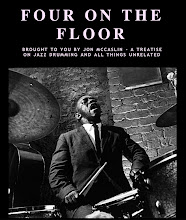
WELCOME TO FOUR ON THE FOUR: A BLOG ABOUT JAZZ DRUMMING AND ALL THINGS UNRELATED, BROUGHT TO YOU BY JON McCASLIN

Sunday, May 31, 2009

Calgary Bound !


Well, the boxes are packed and the movers come tomorrow morning.

I've had a wonderful time in Toronto over the past two years but it's time to move on to a new chapter in my life and tomorrow I'm making the trek out West and moving to Calgary !

I have nothing but great memories from my previous time in Calgary (2004-2007). I first moved to Calgary from Montreal during the summer of 2004 (very last minute I should add!) to join the touring production of "Barrage". I spent a year and a half touring the world with this fiddle group and then when that ran it's course I opted to stay in Calgary and make a go freelancing and teaching.

Calgary is beautiful city full of great people and great musicians. I'm really looking forward to being back out West and contributing to the scene out there.

I already have many exciting opportunities coming up (not the least of which includes getting married this coming July!) and I'm looking forward to playing with the likes of the Brenan Brothers, Neil Whitford and Johnny Summers as well as a few jazz workshops where I'll be teaching.

I hope to reunite my old acquaintances and hopefully make some new ones along the way.

Sadly, I leave behind many great musicians in Toronto that I've worked with over the past couple of years....however, I promise to keep my Toronto roots intact and cheer for the Maple Leafs whenever they come to Calgary (!)

Monday, May 25, 2009

Downbeat Jazz Drummer's Round Table 1964 - Part One

Some interesting comments, opinions and dialogue here - especially about the role of the bass drum and it's time keeping role.
The drummers interviewed include:

Elvin Jones
Joe Morello
Mel Lewis
Cozy Cole
Shelly Manne
Nick Ceroli
Art Blakey
Donald Dean
Tony Williams


Downbeat: Today there may be an overdependence on the bassist for keeping time. Has the switch from bass drum to the hi hat for timekeeping deprived young drummers of essential training? Dizzy Gillespie has been quoted as saying that most drummers-not just young ones – don’t know how to play the bass drum.

Donald Dean: I think what is missing in a lot of potentially good drummers today is the bass drum. I know myself that I really want to know more about it. You get more bottom and you get more balance to the drums themselves. The bass drum should be played more. More in time keeping. It's the touch. It's the way that the bass drum can be felt and not really heard.

Ceroli: Has everybody heard Jake Hanna play with Woody Herman? Now he played the bass drum beautifully, I thought. He played throughout the whole thing, and he just walked the bass drum the same way a bass player walks. But at the same time you had to actually listen for it wasn't really dominating. Once it dominates, you're back in 1938. But the way he played it is the way I'd like to play it.

Morello: I have played it both ways, I have played in bands where I've used the bass drum on all four and I've played it in bands where I just used it for accents and so on. But I am apt to go along with Diz, in that a lot of kids don't put much importance on the bass drum and they should. Take the old Basie band with Jo Jones. The blend of the piano, the bass , guitar and drums was right there. It was never overbearing.

Manne: I don't think the time keeping element has turned to the hi hat. I think it is the right hand. The hi hat just adds an added impulse to the time, to the beat. I think the main time keeping element now is the right hand, not the hi hat. That's why time is important….Because if you have the time feeling, the swinging feeling, you can become as free as you want as long as that basic element is there. If you have that strong a time feeling, you can generate that time feeling without actually pointing the time out….But I agree that when you are playing time, the bass drum should be played. I don't believe it should be boomed out. The cymbal is the main coloration. But the bass drum-away from accents-if it is not there, there is something missing. There is a piece of the bottom missing.

Morello: A lot of young drummers have nothing but top-top sound. You don't hear any bottom to it. The bass drum gives the band a lot of bottom. For instance our bass player, Gene Wright, if I don't play the bass drum in four, he'll look over and sort of nudge me. There've always been arguments between bass players and drummers, like who's gonna lay down the time. But Gene wants to hear that bass drum. It should just blend together perfectly. He feels the bass drum is the basic pulse, and he can put the harmonic structure on it. Kid should learn ---

Jones: Learn how to play the bass drum! Everything that is included in the drumset is there for a purpose and should be learned. Whether you use it consistently or not, you should know how to use it.

Blakey: It isn't a question that they don't know it; it is a question of they don't do it. If they'd do it, they would know. Playing every night is the only way to develop …Not a socko style. I don't think the bass drum should be up above the bass fiddle.

Morello: I think Diz was referring to was that a lot of kids got hooked on this top cymbal- hi hat left hand when that was the thing, like the hi hat was the anchor on 2 and 4. The pulse, of course on 2 and 4, but we don't have to play the hi hat on just 2 and 4; we can play it on 1 and 3 if we want.

Manne: To accentuate the hi hat too much on 2 and 4 takes away a certain quality in your playing. Because 1 and 3 are still the most strongly felt beats whether played or not.

Cole: I think the bass drum is the main instrument in the drums. Why should a drummer be there if he can't keep time? Like Art said, it should not be socko, but it should be two beats when you feel it, four beats when you feel it.

Williams: What if you don't feel it at all?

Cole: Now here is a thing. There are so many leaders that are going along with somebody else, his idea, and they'll get a drummer in there, maybe, that can play a bass drum. And he may say to the drummer, “man, that's old school” and not want him to play the bass drum at all. But believe me, anytime you play the bass drum tastefully without overriding the band, and with a nice sound and have a beat down there, it is one of the greatest assets to a drummer.

Williams: Well what I am trying to say ---well, the way I have been playing is that the beat is there, but I have been playing it with the cymbal, because it still swings.

Lewis: [To Williams] Are you playing your bass drum though?

Williams: No. Not at all.

Lewis: That's unusual because I thought Miles always likes to have a little bass drum.

Blakey: What he is doing is in the group where he's working at. Now, what ever group you're in, you have to let the punishment fit the crime.

Williams: When I hear the hi hat being played on 2 and 4, through every solo, through every chorus, through the whole tune, this seems to me to be ---I can't play it like that. Chit, chit, chit chit -all the way through the tune. My time is on the cymbal and in my head, because when I play the bass drum, I play it where it means something. I just put it in. When a person plays this way, they don't play the bass drum, they don't play the hi hat-well, they say they're playing something free-that word is a drag too. What makes it different is that they don't have any bottom.

Lewis: That is what your bass drum is for.

Blakey: One point of clarity. You cannot depend on the bass fiddle and you can't say the beat is there-maybe the bass fiddle player is not too mature himself-so you do certain things. See everything you got is there-the sock cymbal is one instrument, the ride cymbal is another instrument, your bass drum is another instrument, your snare's another instrument, the tom toms ---all complete, different instruments. You simply cannot leave everything to him [the bassist]. Sometimes you have to come in and say [Blakey states a strong, regular, rapid beat verbally], and after the band gets going, you go “Blam” and go into your other bit. And if they get out of line, you bring them back in, because that's what you are there for. You are the master of this whole thing.

Lewis: The drummer is the leader.

Williams: When I say the bottom is missing, when I speak of the bottom, I don't speak of the bottom being the bass drum. I speak of the bottom as being a certain feeling we get--- a sound. You get it right off of the cymbal.

Cole: Off of the cymbal. Off of the snare drum.

Blakey: You can get it off of a magazine and a pair of brushes. You can get it if you have a beat. Like Denzil Best, the greatest I know for that. Take that cymbal and run you crazy.

Cole: George Shearing had a very nice band, and you would call that a modern band.
Denzil held that band together because he had that feeling---he had a good beat.

Lewis: Here is an important thing about bass drums, about using it. I've heard a lot of groups where the drummer isn't playing the bass drum; he's just depending on cymbals, and not playing too much hi hat and you've got a bass player---he's gonna start moving. He's gonna start driving. So he starts on top, and the tempo starts to skate a little bit. And I hear the drummer go right along with him. All of a sudden the tempo leaps ahead. There's the time to start playing the bass drum a little bit. Hold it back, hold it where it was. Especially if that tempo is grooving-why change it? That's where I think I need all of your facilities. That's what Art was talking about before. Showing them where it is.

Blakey: Whatever groove is stomped off, I think it should end it --- you're not a metronome - but you should end it as close to the original temp as possible, and you should be swinging.

Williams: Since I've been playing, a lot of musicians have told me things like 'Play your hi hat on 2 and 4, and lay time.” But what they don't seem to realize is that I am playing the time, because as soon as the leader says “one -two - three- four.” That's it. There's the time right there. So for as me playing this [ Williams bangs floor to simulate a steady bass drum rhythm], I can't paly it because the time is there. Everyone knows where the time is --- the meter is there.

Blakey: Not everyone is a drummer.

Lewis: And they all don't know where it is.

Blakey: Wait a minute. Saxophone players, trumpet players are virtuosos. They're supposed to be soloist. But do you realize how many musicians don't know anything about rhythm? If they did, they'd be playing like Charlie Parker and Dizzy Gillespie. All of them. They would be at least a reasonable facsimile. But look at them.

Williams: Well those people shouldn't be playing.

Blakey: No, you can't say that. Okay we have 3,000 musicians down in the union. We could say, okay, 2,500 of them should be in the bank or another kind of job, because they know nothing about rhythms. They know nothing about the feel of time, unless you get up underneath them, all night long. Poom. Get up out of there - let's go get up out of the hole.

Williams: Soloists feel what they're playing is always theirs, but it isn't, because when we're playing the time, that's our business. So whatever I'm playing, the soloist will turn around to me and say “Where's the time?” I'm playing the time ---it's just that he doesn't have any knowledge of it. He doesn't know what he's doing.

Blakey: You can take a drum and you can take what we call separation and play one rhythm with this hand on the cymbals - ching chca ching chic aching---play another rhythm with the other hand, play another rhythm on the sock cymbal, play another on the bass drum and say, “Okay, I'm gonna take 16 bars now, I'll even take eight bars. Now you all come in after eight.

Lewis: And they don't know where it is.

Cole: Take a big band's reed section or a brass section-a lot of times they say, “let the drums play with me, then we'll be able to swing.” Those men got to swing by themselves, because you can't make them swing; you can be back there swinging to the nth degree, and if they aren't swinging, they aren't gonna swing. You ghave to be able to swing yourself.

Williams: this is one of the reasons why I enjoy listening to the avant gardehorn players. When I hear them on records, no matter what's happening, they're straight ahead. They're not turning around saying “I wonder what's happening?” they're not worried about that. They're just playing.

Cole: Duke Ellington's band-do you know that brass section can swing? Those fellows come out there and they start swinging themselves. They don't need any drums.

Downbeat: A famous story has it that Benny Goodman used to rehearse his and without the drummer to get them to swing by themselves.

Lewis: Benny always insults the rhythm section by saying, “let's run this over -just instruments.” Like the rhythm section are not instruments. But his idea is good. We got into another thing here that had nothing to do what Tony was talking about before, about the hi hat, the bass drum, and leaving them out and just doing it the way you feel because you are just implying that swing in the time anyway. But not in a big band, Tony. The brass section, the trombone section, the trumpet section, the saxophone section---man they need a drummer.

Downbeat: Well, what does big band experience do for a drummer? What does he learn?

Lewis: It'll make you or break you.

Blakey: It teaches you how to play the arrangements, teaches you to remember. A drummer must have a hell of a memory. You can't be playing i na jazz band and looking at music. You've got to cue the trumpets in, you've got to cue the rhythm section, you've got to bring them in or they'll goof. With a small group, every tub must sit on it's own bottom. It gives the drummer more freedom, it give him chance to play. It gives him a chance fit in things, to fit in patterns, where he can't do it in a big band. You try to do it in a big band and you're in trouble.

Williams: A big band makes you strong too.

Downbeat: Have you ever played in a big band, Tony?

Williams: At the Berklee school. I wasn't going to Berklee, but I'd be at the school sometimes, and they would have ensemble practice.

Lewis: I'm glad for these things they've got going at these schools, because that's the greatest training ground in the world for a young drummer, with a big band. That's when you know you're going to be a drummer or when you are going to quit.

Williams: I know some fellows who play with big bands but can't play with little bands.

Lewis: I know very few little band drummers who can't play with big bands.

Blakey: I came out of Billy Eckstine's band and went to Minton's, and Eddie Lockjaw Davis was working there with Bud Powell and Al McKibbon and Fats Navarro. They got me on the bandstand and said [Blakey uses his hand to indicate an extremely fast tempo], and I was lost. Because we didn't play that way in Eckstine's band. We were a dance band. I was lost for a long time and when I did try to play temp, in about the third chorus I felt like I was gonna drop dead. And I was just mad enough to stay in there and cuss and sweat and jive. I never forget when Cozy came to the Apollo Theater, and I was having trouble and I had a lot of sand in my eyes - I couldn't see the music too good. I was sitting there trying to count, and he called me off the stand and said, “Hey Art, when you're in trouble, roll.” So, that's what I did all that night.

Lewis: One thing I enjoy about playing with Gerry Mulligan's big band is that I can be a big band drummer and a small band drummer at the same time.

Morello: In my way of thinking, big band work is a little bit more restricted than small group work. The main job in a big band is to keep that herd together. In a small group you have to be a little more flexible; there's give and take. In a big band you can't give too much; you have to push straight ahead. I think it's important if the drummer, the amateur, can rehearse with a big band. Today the big bands are nothing like they were in my younger days and I'm not that old. There are very few good bands going now and I find it is difficult for a youngster to get a chance to play with a big band. But there are a lot of rehearsal bands and it's good experience for a kid to get up there and play. It'll help his reading. It'll help him interpret a chart. It'll develop his assurance too.

Jones: The little bit of big band experience I have had has given me a tremendous insight - which I hadn't had before --- into the harmonic and the melodic … all of the intricate lines, cross melodic lines that you wouldn't hear ordinarily. You hear a whole section playing a line and then another one playing a cross melodic line back and forth, and you're right in the middle keeping it all together. That's a tremendous experience and it gives you a much deeper understanding of what the music is all about, of what's really going on.

Ceroli: I hate to sound monotonous but big band playing is going to keep to help keep his time together

Manne: I think it teaches him discipline. That's really important for a drummer.

Ceroli: When you walk up on a big band, you've got to hold that band together. And you've got to know how to play that band. It just isn't time.

Manne: That's right. It is like the stick that bends. You've got to give and take. You can still play time, but you've got to slow down and speed up a little. I don't mean speed up and slow down so that somebody can say, “Oh my God, he's slowing down,” but it is kind of like a feeling that you give and take, like when the brass starts shouting.

Sunday, May 24, 2009

Lewis Nash

Lewis Nash is one of my all time favorite contemporary jazz drummers.

Here's a couple clips of Lewis playing some duets with saxophonist Steve Wilson.


And here's a short of Lewis Nash going nuts at a jam session on stage at some jazz festival.
I've always loved the way he tunes his drums and gets such a melodic quality from his phrasing.

Saturday, May 23, 2009

Smalls Jazz Club Live Video Feed

When I was making my treks to NYC during the winter/spring of 2004 to study with Matt Wilson on my Canada Council for the Arts sponsored sojurn, the jazz club "Small's" located in Greenwich Village was always my go-to jazz club if I didn't know where else to go or didn't feel like spending a small fortune at one of the other bigger and more touristy jazz clubs like the Blue Note or the Vanguard (although I always tried to take in the Village Vanguard whenever I could).

I was always impressed by the amazing talent that I heard at Small's including younger and older jazz musicians alike that aren't known outside of New York. I always knew I would hear something good at this club even if I had no idea who any of the musicians were!

Anyways, this is a great find...

Small's has now installed a camera and microphone and provides a live-feed of all there nightly concerts.

WOW !!!

I'm really digging this... : )

SMALLS JAZZ CLUB LIVE VIDEO FEED

http://www.smallsjazzclub.com/index.cfm?itemCategory=32338&siteid=272&priorId=0&banner=a

Apparently they are going to start archiving all these shows so there should be lots of good music to check out !

Thank You !

My DMA recital last Wednesday was a resounding success and I'd like to thank the following people for making it such a great experience.

Thanks to all the musicians involved who brought my music to life and did such a great job navigating my crazy tunes:

Patrick Boyle
Brendan Cassidy
Tom Van Seters
Kieran Overs

I'd also like thank all my teachers I've worked with during my time at the U of T during the past two years:

Terry Promane
Paul Read
Tim Ries
Chase Sanborn
Terry Clarke
Bob McLaren
John Brownell
Gary Williamson
Russell Hartenberger
Kwasi Dunyo

Here are the program notes from my recital:


Monday, May 11, 2009

It's Recital Time !


Don't miss my upcoming DMA recital next week !

Here's the details:

Jon's DMA Performance Recital

Wednesday, May 20th 2009

7:30pm

Walter Hall
Edward Johnson Music Building
University of Toronto
(museum subway stop)

Featuring:

Jon McCaslin - Drums

Patrick Boyle - Trumpet

Brendan Cassidy - Tenor Saxophone

Tom Van Seters - Piano

Kieran Overs - Bass


I'll be performing music that I've been composing and working on for the past year. I will also be playing some vibraphone.

Wednesday, May 6, 2009

Has Anyone Seen...

...one of these unique contraptions ???


It's like a regular 16x16 floor tom, except it has a pedal attached and you can change the pitch of the drum by pressing on the pedal. Just like a tympani - except it's a floor tom.

These were made by an Italian company back in the 70s and so did Yamaha at some point.

Max Roach used one extensively during the 70s and 80s.
He makes it sound like a West African Talking drum. I think Ed Blackwell did too.
Very cool.

If anyone has one they would be willing to part with, please contact me !

Thursday, April 30, 2009

It's Hammer time !

Tonight I heard Diana Krall and her quartet perfrom at Massey Hall in Toronto. I originally had a ticket to see Charlie Haden's Quartet West last week (which I was very, very much looking forward to - I heard them in Calgary last summer and they were outstanding, especially Rodney Green on drums) but the show was cancelled so I used my credit to see Krall instead.

I probably would have opted to see Brad Mehldau or Ornette Coleman next fall, but I'm moving back to Calgary very soon and wanted to use my ticket credit before I leave.

However...the ever musical and hard swinging Jeff Hamilton was playing drums with Diana Krall's band and he swung hard and gave it his all from the very first note. It was awesome.

His sense of swing, great touch on his cymbals and, of course, his impeccable brush work was really something else. My seat was in the front row of the balcony, directly stage left - so I had the best seat in the house (for a drummer!) and had a perfect and unobstructed view of Hamilton's drumming. Every nuance, cymbal tap and brush stroke. It was like a drum lesson.

Here's a few videos that I came across that show what a swinging monster Jeff Hamilton is on the drums:


And don't forget about the limited edition, Jeff Hamilton "Man of Action" action figure !

(credit goes to Kristin Korb for this one...)

Monday, April 27, 2009

Jon plays some drums and pretends to be Art Blakey !


I spent the afternoon today in the recording studio playing with the University of Toronto Jazz Outreach Ensemble. I've been playing with this group all year and acted as a teaching assistant for the ensemble. The mandate of this group has been to go out into schools in the GTA and spread the good word that is jazz music (or as Prof. Gordon Foote calls it: "Stomping out Jazz ignorance"!)

Here's a clip of me playing on the tune "Mosaic" written by Cedar Walton, originally recorded by Art Blakey & The Jazz Messengers back in the 1960s.

I recorded this on my Flip handheld video recorder, set-up next to the drums.

For any drum geeks out there, the drum solo starts around  the 6 minute mark : )


I should also like to add what a pleasure it's been playing with this fine ensemble all year.
Specifically I would like to thank the following people for all their fine musicianship and hard work:

Patrick Boyle - trumpet
Brendan Cassidy - alto
Ben Dietschi - tenor
Anthony Rinaldi - bari
Robin Jessome - trmbn
Nathn Hiltz - guitar
Rob Fekete - piano
Mark Godfrey  - bass

Also a special thanks to Chase Sanborn who oversaw the band and did an excellent job today acting as our producer and as the "man in the booth". He kept everyone relaxed and focused. It was a fun session and I'm quite looking forward to hearing the results.

I hope this video clip loads properly.

Saturday, April 25, 2009

mmmm...Food ! 2.0

Seeing that spring is here and barbque season is nearly upon us, check this one out.

My brother in North Carolina has already got his "que" started and showed me this.

Any hamburger fans out there will enjoy this variation of the cheesburger:

The Juicy Lucy

Basically, you cook your burger with the cheese INSIDE in the meat patty.
Cool.
Maybe not so cool if you are a vegetarian.

http://en.wikipedia.org/wiki/Jucy_Lucy

Friday, April 24, 2009

Elvin Jones

Here's some Elvin Jones to get the weekend off to a good start : )


That's Toronto's own Pat LaBarbera on soprano saxophone !

Tuesday, April 21, 2009

Only in New York...


I love it how the fact that a pink gorilla and cookie monster are playing ragtime on a NYC subway platform and yet most of the commuters are completely unfazed and indifferent to this !

Monday, April 20, 2009

mmmm...Food !


My other favorite pastime besides jazz and drumming is eating.

My brother sent me this recipe for an interesting Spanish dish called Paella.

If anyone makes this and gets sick, I take no responsibility!

Looks pretty good though...

PAELLA

Ingredients:

* 1/4 cup good olive oil
* 1 1/2 cups chopped yellow onion (2 onions)
* 2 red bell peppers, cored and sliced into 1/2-inch strips
* 2 tablespoons minced garlic (4 to 6 cloves)
* 2 cups white basmati rice
* 5 cups good chicken stock, preferably homemade
* 1/2 teaspoon saffron threads, crushed
* 1/4 teaspoon crushed red pepper flakes
* 1 tablespoon kosher salt
* 1 teaspoon freshly ground black pepper
* 1/3 cup licorice-flavored liqueur (recommended: Pernod)
* 1 1/2 pounds cooked lobster meat
* 1 pound kielbasa, sliced 1/4 to 1/2-inch thick
* 1 (10-ounce) package frozen peas
* 1 tablespoon minced fresh flat-leaf parsley leaves
* 2 lemons, cut into wedges

Directions

Preheat the oven to 425 degrees F.

Heat the oil in a large ovenproof Dutch oven. Add the onions and cook over medium-low heat for 5 minutes, stirring occasionally. Add the bell peppers and cook over medium heat for 5 more minutes. Lower the heat, add the garlic, and cook for 1 minute longer. Stir in the rice, chicken stock, saffron, red pepper flakes, salt, and pepper and bring to a boil. Cover the pot and place it in the oven. After 15 minutes, stir the rice gently with a wooden spoon, and return it to the over to bake uncovered for 10 to 15 more minutes, until the rice is fully cooked.

Transfer the paella back to the stove top and add the licorice-flavored liqueur. Cook the paella over medium heat for 1 minute, until the liqueur is absorbed by the rice. Turn off the heat and add the lobster, kielbasa, and peas and stir gently. Cover the paella, and allow it to steam for 10 minutes. Sprinkle with the parsley, garnish with lemon wedges, and serve hot.

Put on Miles Davis/Gil Evan's "Sketches of Spain" and enjoy !

Sunday, April 19, 2009

Some Rudiments To Practice...

I came up with these variations on the rudiment commonly known as the "Swiss Army Triplet."
Tony Williams was known for his creative use of this pattern around the drum set during the 70's.

I just recently figured out how to create drum parts and notation on Sibelius after having this great program on my computer for almost seven years now !

So I'm pleased to share my first attempts with you.


SWISS ARMY TRIPLET VARIATIONS

The basic idea is that you make the last note of each swiss army triplet an accented flam.

Consequently, the lead hand ends up playing a steady stream of eighth notes with an accent on the first beat.
It's a bit of a chop buster so take it slow and relax.

I'm not an expert, but I think these would be good patterns to apply the Moeller stroke to a rhythmic pattern.

(I'm going to see JoJo Mayer give a clinic next month so I'll see then what he reveals about the fabled "Moeller" stroke)

I've written out this pattern four different ways.

1) Triplets - Right Hand Lead


2) Triplets - Left Hand Lead


3) Eighth Notes - Right Hand Lead


4) Eighth Notes - Left Hand Lead


Okay, now go get your drum pad and get to work !

Saturday, April 18, 2009

Ali Jackson Jr. on Nintendo's Wii Music

I thought this was great.

Ali Jackson Jr. (fine drummer with the Lincoln Centre Jazz Orchestra and Wynton Marsalis) demonstrates a music game for Nitendo's Wii.

He also talks about what it means to swing - which he even manages to do with a video game !

ALI JACKSON JR. PLAYING NINTENDO Wii


Ali Jackson, Jr. on Wii Music from Ali Jackson on Vimeo.


Here's another of clip of Ali playing some mean ass brushes with Wynton Marsalis.
I think they are playing "Blue n'Boogie" from the Miles Davis Album "Walkin" ?


ALI JACKSON WITH WYNTON MARSALIS

Ali Jackson with Wynton Marsalis Quintet (10/05) from Ali Jackson on Vimeo.

Friday, April 17, 2009

Lewis Nash vs. Bobby Hutcherson

Two of my heroes going at it on "Solar"

I think I'm going to go practice now...


LEWIS NASH & BOBBY HUTCHERSON - SOLAR

Lewis Nash Trading Fours

Thursday, April 16, 2009

It's all about the Moves...

wow.

Check out this guy's crazy moves !

CRAZY KOREAN DRUMMER


Okay...now on a more serious note....here's some Tony Williams from 1972 with Stan Getz, Stanley Clarke and Chick Corea.
Check out the expression on Stan Getz's face after Tony is done his solo !


TONY WILLIAMS - 1972

Wednesday, April 15, 2009

The Place Of Music In Society

Someone sent me this great speech given to the freshman class at the Boston Conservatory as given by Karl Paulnack, pianist and director of music division at Boston Conservatory:

"One of my parents' deepest fears, I suspect, is that society would not properly value me as a musician, that I wouldn't be appreciated. I had very good grades in high school, I was good in science and math, and they imagined that as a doctor or a research chemist or an engineer, I might be more appreciated than I would be as a musician. I still remember my mother's remark when I announced my decision to apply to music school-she said, "You're WASTING your SAT scores." On some level, I think, my parents were not sure themselves what the value of music was, what its purpose was. And they LOVED music, they
listened to classical music all the time. They just weren't really clear about its function. So let me talk about that a little bit,
because we live in a society that puts music in the "arts and entertainment" section of the newspaper, and serious music, the kind your kids are about to engage in, has absolutely nothing whatsoever to do with entertainment, in fact it's the opposite of entertainment. Let me talk a little bit about music, and how it works.

The first people to understand how music really works were the ancient Greeks. And this is going to fascinate you; the Greeks said that music and astronomy were two sides of the same coin. Astronomy was seen as the study of relationships between observable, permanent, external objects, and music was seen as the study of relationships between invisible, internal, hidden objects. Music has a way of finding the big, invisible moving pieces inside our hearts and souls and helping us figure out the position of things inside us. Let me give you some examples of how this works.

One of the most profound musical compositions of all time is the Quartet for the End of Time written by French composer Olivier Messiaen in 1940. Messiaen was 31 years old when France entered the war against Nazi Germany. He was captured by the Germans in June of 1940, sent across Germany in a cattle car and imprisoned in a concentration camp.

He was fortunate to find a sympathetic prison guard who gave him paper and a place to compose. There were three other musicians in the camp, a cellist, a violinist, and a clarinetist, and Messiaen wrote his quartet with these specific players in mind. It was performed in January 1941 for four thousand prisoners and guards in the prison camp. Today it is one of the most famous masterworks in the repertoire.

Given what we have since learned about life in the concentration camps, why would anyone in his right mind waste time and energy writing or playing music? There was barely enough energy on a good day to find food and water, to avoid a beating, to stay warm, to escape torture-why would anyone bother with music? And yet-from the camps, we have poetry, we have music, we have visual art; it wasn't just this one fanatic Messiaen; many, many people created art. Why? Well, in a place where people are only focused on survival, on the bare necessities, the obvious conclusion is that art must be, somehow, essential for life. The camps were without money, without hope,without commerce, without recreation, without basic respect, but they were not without art. Art is part of survival; art is part of the human spirit, an unquenchable expression of who we are. Art is one of
the ways in which we say, "I am alive, and my life has meaning."

On September 12, 2001 I was a resident of Manhattan. That morning I reached a new understanding of my art and its relationship to the world. I sat down at the piano that morning at 10 AM to practice as was my daily routine; I did it by force of habit, without thinking about it. I lifted the cover on the keyboard, and opened my music, and put my hands on the keys and took my hands off the keys. And I sat there and thought, does this even matter? Isn't this completely irrelevant? Playing the piano right now, given what happened in this city yesterday, seems silly, absurd, irreverent, pointless. Why am I here? What place has a musician in this moment in time? Who needs a piano player right now? I was completely lost.

And then I, along with the rest of New York, went through the journey of getting through that week. I did not play the piano that day, and in fact I contemplated briefly whether I would ever want to play the piano again. And then I observed how we got through the day.

At least in my neighborhood, we didn't shoot hoops or play Scrabble. We didn't play cards to pass the time, we didn't watch TV, we didn't shop, we most certainly did not go to the mall. The first organized activity that I saw in New York, that same day, was singing. People sang. People sang around fire houses, people sang "We Shall Overcome". Lots of people sang America the Beautiful. The first organized public event that I remember was the Brahms Requiem, later that week, at Lincoln Center, with the New York Philharmonic. The first organized public expression of grief, our first communal response to that historic event, was a concert. That was the beginning of a sense that life might go on. The US Military secured the airspace, but recovery was led by the arts, and by music in particular, that very night.

From these two experiences, I have come to understand that music is not part of "arts and entertainment" as the newspaper section would have us believe. It's not a luxury, a lavish thing that we fund from leftovers of our budgets, not a plaything or an amusement or a pass time. Music is a basic need of human survival. Music is one of the ways we make sense of our lives, one of the ways in which we express feelings when we have no words, a way for us to understand things with our hearts when we can't with our minds.

Some of you may know Samuel Barber's heartwrenchingly beautiful piece Adagio for Strings. If you don't know it by that name, then some of you may know it as the background music which accompanied the Oliver Stone movie Platoon, a film about the Vietnam War. If you know that piece of music either way, you know it has the ability to crack your heart open like a walnut; it can make you cry over sadness you didn't know you had. Music can slip beneath our conscious reality to get at what's really going on inside us the way a good therapist does.

I bet that you have never been to a wedding where there was absolutely no music. There might have been only a little music, there might have been some really bad music, but I bet you there was some music. And something very predictable happens at weddings-people get all pent up with all kinds of emotions, and then there's some musical moment where the action of the
wedding stops and someone sings or plays the flute or something. And even if the music is lame, even if the quality isn't good, predictably 30 or 40 percent of the people who are going to cry at a wedding cry a couple of moments after the music starts. Why? The Greeks. Music allows us to move around those big invisible pieces of ourselves and rearrange our insides so that we can express what we feel even when we can't talk about it. Can you imagine watching Indiana Jones or Superman or Star Wars with the dialogue but no music? What is it about the music swelling up at just the right moment in ET so that all
the softies in the audience start crying at exactly the same moment? I guarantee you if you showed the movie with the music stripped out, it wouldn't happen that way. The Greeks: Music is the understanding of the relationship between invisible internal objects.

I'll give you one more example, the story of the most important concert of my life. I must tell you I have played a little less than a thousand concerts in my life so far. I have played in places that I thought were important. I like playing in Carnegie Hall; I enjoyed playing in Paris; it made me very happy to please the critics in St. Petersburg. I have played for people I thought were important; music critics of major newspapers, foreign heads of state. The most important concert of my entire life took place in a nursing home in Fargo, ND, about 4 years ago.

I was playing with a very dear friend of mine who is a violinist. We began, as we often do, with Aaron Copland's Sonata, which was written during World War II and dedicated to a young friend of Copland's, a young pilot who was shot down during the war. Now we often talk to our audiences about the pieces we are going to play rather than providing them with written program
notes. But in this case, because we began the concert with this piece, we decided to talk about the piece later in the program and to just come out and play the music without explanation.

Midway through the piece, an elderly man seated in a wheelchair near the front of the concert hall began to weep. This man, whom I later met, was clearly a soldier-even in his 70's, it was clear from his buzz-cut hair, square jaw and general demeanor that he had spent a good deal of his life in the military. I thought it a little bit odd that someone would be moved to tears by that particular movement of that particular piece, but it wasn't the first time I've heard crying in a concert and we went on with the concert and finished the piece.

When we came out to play the next piece on the program, we decided to talk about both the first and second pieces, and we described the circumstances in which the Copland was written and mentioned its dedication to a downed pilot. The man in the front of the audience became so disturbed that he had to leave the auditorium. I honestly figured that we would not see him
again, but he did come backstage afterwards, tears and all, to explain himself.

What he told us was this: "During World War II, I was a pilot, and I was in an aerial combat situation where one of my team's planes was hit. I watched my friend bail out, and watched his parachute open, but the Japanese planes which had engaged us returned and machine gunned across the parachute chords so as to separate the parachute from the pilot, and I watched my friend drop away into the ocean, realizing that he was lost. I have not thought about this for many years, but during that first piece of music you played, this memory returned to me so vividly that it was as though I was reliving it. I didn't understand why this was happening, why now, but then when you came out to explain that this piece of music was written to commemorate a lost pilot, it was a little more than I could handle. How does the music do that? How did it find those feelings and those memories in me?

Remember the Greeks: music is the study of invisible relationships between internal objects. This concert in Fargo was the most important work I have ever done. For me to play for this old soldier and help him connect, somehow, with Aaron Copland, and to connect their memories of their lost friends, to help him remember and mourn his friend, this is my work. This is why music matters.

What follows is part of the talk I will give to this year's freshman class when I welcome them a few days from now. The responsibility I will charge your sons and daughters with is this:

"If we were a medical school, and you were here as a med student practicing appendectomies, you'd take your work very seriously because you would imagine that some night at two AM someone is going to waltz into your emergency room and you're going to have to save their life. Well, my friends, someday at 8 PM someone is going to walk into your concert hall and bring you a mind that is confused, a heart that is overwhelmed, a soul that is weary. Whether they go out whole again will depend partly on how well you do your craft.

You're not here to become an entertainer, and you don't have to sell yourself. The truth is you don't have anything to sell; being a musician isn't about dispensing a product, like selling used Chevies. I'm not an entertainer; I'm a lot closer to a paramedic, a firefighter, a rescue worker. You're here to become a sort of therapist for the human soul, a spiritual version of a chiropractor, physical therapist, someone who works with our insides to see if they get things to line up, to see if we can come into harmony with ourselves and be healthy and happy and well.

Frankly, ladies and gentlemen, I expect you not only to master music; I expect you to save the planet. If there is a future wave of wellness on this planet, of harmony, of peace, of an end to war, of mutual understanding, of equality, of fairness, I don't expect it will come from a government, a military force or a corporation. I no longer even expect it to come from the religions of the world, which together seem to have brought us as much war as they have peace. If there is a future of peace for humankind, if there is to be an understanding of how these invisible, internal things should fit together, I expect it will come from the artists, because that's what we do. As in the concentration camp and the evening of 9/11, the artists are the ones who might be able to help us with our internal, invisible lives."

This very much very reminds of what Art Blakey used to say:

"Jazz music washes away the dust of everday life!"

Monday, April 13, 2009

Music I'm Listening To These Days...


People often ask me what music I am listening to.

Here's some albums that have been making the rounds lately:


Eric Dolphy    
"Out To Lunch"  
Tony Williams (drums)
Bobby Hutcherson (vibes)

Jason Marsalis  
"Music Update"  
David Potter (drums) Jason Marsalis  (vibes)

Jeff "Tain" Watts  
"Tain"  
Jeff "Tain" Watts (drums)

Rob Fekete  
"Ternary"  
Anthony Michelli (drums)

Karl Berger  
"Transit"  
Ed Blackwell (drums)

Duke Ellington & Ray Brown
"Duets"

Clark Terry  
"Serenade To A Bus Seat"   
Philly Joe Jones (drums)

Joshua Redman  
"Blues For Pat"  
Billy Higgins (drums)

The Blue Note 7
"Mosaic - A Celebration of Blue Note Records"
Lewis Nash (drums)

Joe Lovano
"Trio Fascination"
Elvin Jones (drums)

Joshua Redman Trio
"Back East"
Ali Jackson Jr. & Brian Blade (drums)

Sunday, April 12, 2009

Jon McCaslin Vibraphonist ?

Much to my surprise I discovered how much I enjoy playing the vibraphone about 3 years ago.

I had two experiences in 2006 that convinced me to take up this metal beast. First, while teaching at the Sasktel Saskatchewan Jazz Festival I had the opportunity to hear the great Bobby Hutcherson and his quartet (with Canadian ex-pat Renee Rosnes on piano, Dwayne Burno on bass and the under-rated Eddie Marshall on drums). Hutcherson is a contemporary of Herbie Hancock, Wayne Shorter, Tony Williams and that whole 60's crew. That concert, held in the old Broadway Theatre in Saskatoon, Saskatchewan will forever be one of the most memorable musical experiences I've ever witnessed.

Fast forward to the fall of 2006 and I found myself in Havana, Cuba participating in Aldo Mazza's KoSa Cuba Percussion Workshop. A bunch of us wandered down to some basement jazz club one night and heard an amazing young vipraphonista by the name of Tamara Castaneda. WOW !!! The best description I can use is to imagine a cross between Gary Burton and Chucho Valdez. I think she's done some work with the Afro-Cuban All-Stars but other than that I don't think she has done anything outside of Cuba. I bought her CD (which was obiviously homemade) but unfortunately it didn't work once I brought it back to Canada. She was amazing and I hope to hear more of her in the future.

So once I returned to Calgary I rented a vibraphone for several months and decided I wanted to take a serious look at this amazing instrument. Vibraphonist Arnold Faber was nice enough to give me a few lessons to get me started and my fellow percussionists Bob Fenske and Malcolm Lim gave me some suggestions to deal with the technical side of things.

Since moving to Toronto in the fall of '07, I've since acquired my own beautiful vintage M-55 set of vibes and have studied with percussionist John Brownell and improvisation with jazz pianist Gary Williamson.

I've even put together a fun band that gets together on a weekly basis, comprised of jazz musicians playing their "second" instruments. The "Goat" band, as our drummer puts it, is made up of myself on vibraphone, Tom Van Seters on drums, Rob Fekete on bass, Ben Dietschi on piano and Patrick Boyle on guitar (in theory!) and sub-bass. Things are going very well and we'll be playing a week at the Village Vanguard next month (haha...no not really!)

So far my process has been to learn all my favorite tunes, get my scales together and generally improve my proficiency at getting around the instrument. Somebody gave me a copy of all the Aebersold volumes so I've shedding along to those quite a bit. It's very refreshing to be thinking about playing music but from a different perspective after all these years of being strictly a drum set player dealing mostly with rhythm. Actually, I've been playing as much vibes as drum set these days and it's something that I hope to improve upon and continue for the rest of my life. 

My current focus on melody and harmony has really enhanced and expanded my approach to being a drummer. I would highly recommend any jazz drummer to check out the vibes in order to expand their understand of total music. I've always tooled around on the piano and I do all my composing/arranging at the piano, but in terms of performance practice - I'm a real hack (!) I know a lot of drummers who are very proficient piano players, but there is really something to be said about being a drummer and being able to express melody and harmony with TWO sticks/mallets on a percussion instrument ! 

Although in the case of the vibes, four mallets would be appropriate. But I've resigned to sticking with two. The four mallet approach, while definately the way to go to fully exploit the possibilities of the instrument (check out Gary Burton, Stefon Harris and Joe Locke!!!), this is going to require way too much time for me to fully master. So I'll be happy to stick with an old school two mallet approach. That's more than enough for me to handle these days. Besides, I have a DMA dissertation to write !

But, two mallets worked for Milt Jackson and Lionel Hampton (not to mention Toronto vibraphonists Don Thompson and saxphonist-turned-vibesman Del Dako) so there is hope for me !

My only regret about all of this is that I didn't start all of this earlier !
For the most part, I kind of brushed off any attempts to learn mallet instruments when I was in the Regina Lions Band or in high school. At the time, I just wanted to be a hot-shot rudimental snare drummer and drum set player. 

So my message to all you young drummers out there: 

LEARN MALLET INSTRUMENTS !!!

Oh well, I guess it's never too late is it ? : )

Here's a clip of my hero Milt Jackson playing Billy Strayhorn's "Take The A Train" at a master class somewhere in Europe.


MILT JACKSON "TAKE THE A TRAIN"