Three unique and interesting videos featuring Kenny Clarke today.
First up, a wonderfully melodic drum solo interpretation of Charlie Parker's bebop anthem Now's the Time. I've never heard this one before nor do I know which album it's from. But if I had to guess, perhaps it's an outtake from one of his sessions recorded for Savoy? (*Editors Note: after some internet sleuthing, I think it's from this album recorded with Ernie Wilkins: https://en.wikipedia.org/wiki/Kenny_Clarke_%26_Ernie_Wilkins)
And here's a rare selection and a dazzling display of the drum set featuring Klook, from the LP Spotlight on Percussion, also recorded circa. 1955:
And finally, a drum exchange between Kenny Clarke and British jazz drummer Kenny Clare (and in colour!):
Please join us for the next episode of Four on the Floor *Live* happening next Wednesday, June 22nd at 12pm mountain (2pm eastern/11am pacific), appearing on Instagram Live IGTV @fouronthfloorblog featuring George Marsh, author of the book Inner Drumming.
At fifteen George Marsh became a professional drummer in Belleville, Illinois. His early experiences included work with Sam Andria, Jimmy Williams, and Barbara Streisand (before she became a super star). He studied percussion with Tom Siwe and Jack McKenzie at Champagne-Urbana, and later played with the Lyric Opera of Chicago, Judy Roberts Trio, John Klemmer, William Russo's experimental big band, The Chicago Contemporary Chamber Players and many great Chicago jazz musicians.
Since 1968, he has lived in the San Francisco area where he has performed and recorded with musicians such as: Denny Zeitlin, David Grisman Quintet/Sextet, Jerry Garcia, John Abercrombie, Mose Allison, Smith Dobson, Joe Henderson, Art Lande, Harold Land, Terry Riley, William Allaudin Mathieu, Pauline Oliveros, Kronos Quartet, Mel Martin, etc. If you were around in 1970, perhaps you caught him with Chuck Berry, Loading Zone or The Jerry Hahn Brotherhood at the Fillmore West and East.
I started teaching shortly after I got my first drumset at age 12. There were very few jazz drummers in Belleville and the surrounding area at the time (1953) and I had learned a lot by seeing Gene Krupa, Papa Jo Jones, and Buddy Rich at Jazz At The Philharmonic concerts. I can still feel the excitement when I saw Count Basie with Sonny Payne on drums! A little later when I was in high school I would go to Peacock Alley in St. Louis and see Philly Joe Jones, Max Roach, Art Blakey - all at the young age of 16.
George has written percussion music for such films as Never Cry Wolf and The Black Stallion. He premiered a suite of his pieces for chamber ensemble in the fall of 2002 at the Lincoln Center in New York which featured Rich Fudoli (reeds), David Wessel (interactive electroacoustics), and Mel Graves, bass. And he also performed on this same concert with Timeless Pulse featuring Pauline Oliveros (just intonation accordion), Thomas Buckner (vocals), Jennifer Wilsey (percussion), and David Wessel (interactive electroacoustics).
George has taught drumming and rhythm theory at the University of California at Santa Cruz since 1982 and at Sonoma State University. He also teaches remotley from his private studio in Santa Rosa California. His book, Inner Drumming is a highly praised and unique manual for drummers.
This book is an instruction manual that offers ways to enhance internal awareness while playing with one, two, three and finally all four limbs. The method allows the drummer to de-condition pathways of inappropriate reflexive responses that often appear when body energy is not flowing most efficiently.
When you play the drums you are already experiencing Inner Drumming, if not consciously, then subconsciously. The easiest way to experience this is to play a simple rhythm with two hands. Playing
hand to hand is basic to all drumming and all drummers do it naturally. As you play hand to hand, slow the motions way down while feeling deeply what’s going on inside your body, what’s happening between the strokes. In deep slow-motion, be internally aware of your movement from limb to limb. This increased awareness is what I call Inner Drumming.
Filmed and directed by Ossie Michelin for the National Film Board of Canada, Evan’s Drum is the beautiful story of an adventurous seven-year-old boy from Happy Valley-Goose Bay, Newfoundland. Evan is part of a new generation of Labrador Inuit who are among the first in living memory to grow up with the sounds of drum dancing since birth.
An adventurous young boy and his determined mother share a passion for Inuit drum dancing in Happy Valley-Goose Bay. Evan’s Drum is a joyful visit to a family’s loving home, and an uplifting story of cultural pride. After generations of silence, the rhythm of the traditional Inuit drum has returned to Labrador, and seven-year-old Evan is part of the new generation that will keep its heartbeat strong.
Please join us for the first episode of Four on the Floor *Live* Season Two (!) happening next Tuesday, June 14th at 12pm mountain (2pm eastern), appearing on Instagram Live IGTV @fouronthfloorblog featuring Dan Weiss!
Two-time Shifting Foundation Grantee Dan Weiss has been hailed as one of the top five jazz drummers by The New York Times and his large ensemble recording “Fourteen” made their top ten list of the best records of 2014. Weiss’s innovative drumming and forward thinking compositions have been pushing musical limits for decades.
Weiss's intense study of jazz, classical Indian, contemporary classical, West African, and metal sets a musical platform that creates a sound that transcends conventional style or genre. His compositional trademarks are angular yet emotive melodies; long rhythmic cycles native to many non-western music, complex through-composed drum parts, and melodic shapes drawing directly from the raga system found in Indian classical music.
Weiss has been studying tabla under Samir Chatterjee for twenty five years. He’s performed classical Indian music with the legendary Ashish Khan and Ramesh Misra, and recorded the tabla solo cd, “3dcd” (2007). Weiss also recorded two unprecedented cds, “Teental Drumset Solo” (2005) and “Jhaptal Drumset Solo” (2011) where he performs classical Indian repertoire on drum set.
With his trio, which includes Jacob Sacks and Thomas Morgan, he’s released three records ('Now Yes When’, 'Timshel', and ‘Utica Box’ ) which have been critically acclaimed for their unique approach to song structure and endless creative improvisation. This band has toured Europe, the United States, and Puerto Rico.
Weiss also leads a unique sixteen piece large ensemble that features some of NYC’s most gifted musicians including Miguel Zenon and Jen Shyu. The two albums 'Fourteen' (2014) and 'Sixteen: Drummers Suite' (2016) released on the Pi record label have made numerous critic polls.
His latest project 'Starebaby' blends metallic jazz, prog and post rock that melds deep sophistication with visceral impact. The band has been featured in The New York Times, toured the US and Europe, and played the prestigious North Sea Jazz Festival. Starebaby’s second record called ‘Natural Selection’ was released in 2020.
As a sideman, Weiss has played/toured with Lee Konitz, Chris Potter, Noah Preminger, Kenny Werner, Rudresh Mahanthappa, David Binney, John Zorn, and many others.
Weiss is currently working on a new trio project (new album in 2022) and a duo project with Miles Okazaki (double vinyl release scheduled for late 2021).
In addition to his musical projects, Weiss is a highly sought-after teacher. He’s currently working on an instructional course and book.
And....we're back and sorry for the radio silence Lol. I was out of town, recording with some friends all last week and unfortunately discovered the hard way that Google's Blogger isn't actually compatible with my iPad mini (!)
Anyhow, today's offering is a trio of unique clips featuring the influential style of the great Afro-Beat drumming legend Tony Allen, a drummer that Brian Eno once called "perhaps the greatest drummer ever" and "probably the most important musician of the last 50 years".
I think the following videos are amazing and recently discovered them while studying Tony Allen's drumming style in preparation for last Spring's Decidedly Jazz Danceworks production of Family of Jazz.
A couple of new books arrived in my mailbox recently and today I'm going to share them with you all.
I think that one of the bright sides of the challenges of the past two years, over the course of the COVID-19 pandemic, is that many people had the motivation to invest their time and channel their positive energy into new projects and creative ventures.
Ireland's Conor Guilfoyle and Iowa's James Dreier are two accomplished drummer/authors who did just this and they have both recently self-published two wonderful new drum books that offer a wealth of information and challenging things to practice and think about.
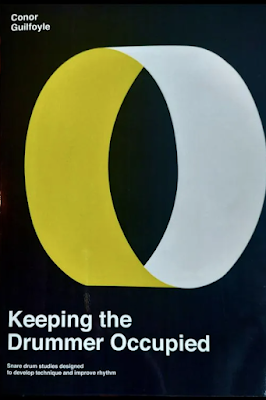
Keeping the Drummer Occupied - by Conor Guilfoyle
I've known Conor for some time now and he is no stranger to writing interesting drum books and sharing his great exercises and compelling concepts via his YouTube channel.
The exercises that Conor has written are concise, practical and offer a variety of concepts and skills that will undoubtedly expand a drummer's vocabulary by using rudiments in creatively different ways.
Keeping the drummer occupied. These 40 studies provide an interesting and challenging way to practice your rudiments. Each study is designed to develop both rhythmic ability and hand technique by utilising familiar stickings in unique ways. Singles, doubles, flams, rolls, and paradiddles are all presented using a combination of unusual rhythmic groupings as well as odd time signature giving you an insight into many of the rhythmic devices found in the contemporary music of today. Also included is a challenging snare drum etude which can be used as a performance or audition piece.
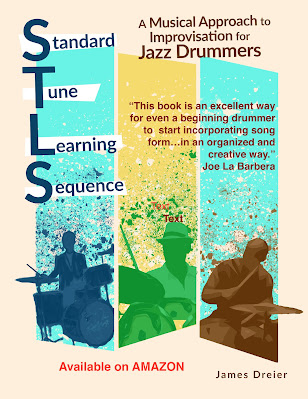
Standard Tune Learning Sequence: A Musical Approach to Improvisation for Jazz Drummers - by James Dreier
James Dreier's new book is a welcome addition to the canon of jazz drumming literature, in which he offers practical approaches to drum improvisation using song form and melody as guiding features.
Dreier's step-by-step approach to using melody and form as reference points and organizing principles while soloing on the drums was an important influence in my own research.
While books that deal with specific patterns, coordination, technique, etc. are very important I also feel that books and approaches such as Dreier's are very important as well because they teach us to think about How and Why we play the drums, not just about What we are playing on the drums.
My book, Standard Tune Learning Sequence, A Musical Approach to Improvisation for Jazz Drummers, is a method book designed to provide jazz drummers with a sequential, organized set of exercises (the STLS sheet), utilizing the act of singing, to learn jazz standards and improvise over them. The book also contains a dozen unique improvisational strategies (along with tune lists, recommended resources etc.), to provide drummers directed and focused ways to utilize the musical elements of any jazz standard for improvisation. It is all designed to provide a more musical foundation for jazz drumming.
There is also a dedicatedYouTube channelthat provides instruction and examples for all the material provided in the book.
"This book is excellent way for even a beginning drummer to start incorporating song form into their daily practice routine in an organized and creative way."
Welcome back to another action packed edition of the Monday Morning Paradiddle, my somewhat regular monthly jazz drumming variety column (sorry, I was too busy to get anything together last month...) Anyways, thank you to all of you who've e.mailed me and I appreciate your feedback and contributions.
This column represents a collection of the somewhat random but significant jazz drumming-related pieces (recent and otherwise) that I find inspiring and feel the need to share with the world.
Thanks again for all your support and please don't forget to subscribe to my mailing list on the right hand side of the page. Don't miss out, sign up today and get Four on the Floor sent directly to your inbox!
So, and without any further ado, here is the Spring edition of the Monday Morning Paradiddle. Please enjoy!
8) Curtis Nowosad interviewed by Darrian Douglas for The Working Artist Project podcast:
9) Steve Maxwell Jr. interviews Matt Wilson:
10) A fantastic duo set from Francisco Mela and George Garzone:
11) Quincy Davis continues with his always excellent Q Tips YouTube series with these formidable episodes:
...and this feature from the Avedis Zildjian Cymbal Company:
12) And also from Zildjian, here's John Riley with another episode from his Art of Bop Drumming series:
13) Sara Hagan Backstage interviews Paul Francis, Master cymbal craftsman:
14) Jochen Rueckert interviewed by Pablo Held:
15) Joe Farnsworth offers these two important lessons from the Greats:
16) The prolific Dr. Jazz Talks, Samo Salamon interviews these Master drummers of our time including:
Jeff Williams
Kenny Washington
Billy Drummond
Bill Stewart
17) The Drum Candy Podcast and Thomas Wendt give us 10 Reasons to Love Roy Haynes:
18) Mind Free Drumming from Ra Kalam Bob Moses and Jabali Billy Hart:
...and more great wisdom here from Ra Kalam:
19) Marcus Gilmore and Savion Glover in a fantastic tap and drum duet:
20) Thanks to Ed Soph who shared this incredible footage of Sonny Rollins with Albert "Tootie" Heath on drums:
21) What am I listening to these days?
Freddie Hubbard "Red Clay" - Lenny White (drums)
Allison Miller & Jane Ira Bloom "Tuesday Sessions" - Allison Miller (drums)
Fela Kuti "Live!" - Tony Allen & Ginger Baker (drums)
Max Roach "Long As You're Living" - Max Roach (drums)
Kenny Wheeler "Music for Large and Small Ensembles" - Peter Erskine (drums)
Terry Gibbs "The Terry Gibbs Dream Band" - Mel Lewis (drums)
Don Cherry & Ed Blackwell "Live in Philadelphia 1978" - Edward Blackwell (drums)
Steve Hirsh "So Now - Drumset Orchestra" - Steve Hirsh (drums and cymbals)
22) And today's Final Word goes to the Copasetics, “a social, friendly benevolent club” of musical and tap dance artists dedicated to preserving the memory and spirit of Master tap dancer and entertainer Bill Bojangles Robinson:
The "Copasetics Song" written by Honi Coles and Paul Branker
A rare piece of jazz drumming history today, a long out-of-print drum manual on swing drumming by drummer, actor and comedian Max Bacon, originally published by the Premier Drum Company in 1934.
If I had to guess, I might believe that this is one of the very first jazz drumming manuals or instructional books ever published (ed. note: I know that Gene Krupa and Dave Tough had some books published in the 1930s but I'd have to check the dates...)
I recently came across this book and author via drummer British drummer Daniel Harding's blog.
Here's an excerpt from Max on "Swing" via Harding's website and I think that many of these words still resonate today:
SWING. I cannot imagine a better name, for to me it conveys everything that is expressed in the ultra-modern rhythm. And before we go any farther, I want to pass this feeling on to you; because, until you learn what it is that we are to do, it is no use attempting to learn how it is to be achieved.
What, then, is this “swing”, which is the very essence of successful rhythmic playing to-day? Is it rhythm ?
It is more than rhythm.
It is the very pulse of rhythm – that which beats within rhythm to give it life.
Unless the essential swing is there, the rhythm will cease to inspire: it may even cease to exist. Swing is a very elusive thing, but there is no mistaking it when you hear it. It is a sense of rhythmic balance which moves the whole band as one unit. It is a steady sweeping movement, like the swing of the pendulum of a grandfather clock. To and from: to and from.
That is swing ; and until a band get knack of swinging together, that band will not be a success. The expression of the rhythm is of the same type that you see in that super swing acquired by skilled skaters, dancing upon ice – large regular sweeps. Mind you, this swing is very difficult to acquire at first. It does not come all at once, even to the best musicians. I have often heard a bunch of well-known players get together for amusement and – experienced though they are – it will be quite a while before they begin to swing as a unit. In the same way, it sometimes happens that a band noted for its swing will lose it for a time. Lack of concentration, or over-tiredness is generally the cause.
But when once you get “into” the swing of the rhythm, you will find that you keep it, for the simple reason that a rhythmic movement, with its regular pulse, is the easiest to maintain.
What is the best way to acquire swing, you may well ask. First and foremost, it is a question of temperament: you must like it when you hear it and you must want to do it yourself. As you know, most dance drummers have become such because they were “drum-minded” ; they had in “in” them to become drummers. In just the same way, you must have it in you to feel that swing behind the rhythm. As I say, it is a question of temperament. It is, of course, partly what we call a gift. You must have the gift of a drumming mind. But it can most definitely be acquired to those who will.
There are several ways of helping yourself to get swing into your work. First and foremost, you must listen to those bands that are known to excel in this. Compare them with others and notice the difference. Then try and analyze their work and discover how this difference is produced. By this means, you will find yourself gradually “soaking your system” in swing until it enters your very blood and becomes part of you.
Having thus acquired it, the best way to produce it is to play easily. Do not be strained or forced. And to do this, you must, of course, have a certain amount of technique…..
Remember that the drummer has a very important part to play in swinging the band: and a poor drummer cannot swing a band, even if it is a good one. And the reverse of this is equally true.
Not much time for blogging these days as I'm quite busy playing for the current Decidedly Jazz Danceworks production of Family of Jazz which runs until May 15th.
However, in the meantime, here's a pair of improvised solo performances today to check out from Francisco Mela and Susie Ibarra. I think these are great!
I've been eagerly waiting to watch this one for sometime and now...here it is!
Please watch and appreciate the artistry of the late Paul Motian, in this full-length documentary entitled Motian in Motion, directed by Michael Patrick Kelly.
Feathering the bass drum and how to properly use the bass drum in a straight-ahead context is an important but yet often mis-understood concept. Many drummers underestimate this important timekeeping tool. But don't take my word for it! Check out this excellent episode from Quincy Davis' Q-Tip series on YouTube.com in which Q breaks down how to properly feather the bass drum.
Open Studio offers a preview of their new upcoming course "Rhythm Anthology" with this important demonstration and discussion between bassist Christian McBride and drummer Gregory Hutchinson.
Welcome back to another action packed edition of the Monday Morning Paradiddle, my more-or-less monthly jazz drumming variety column, a collection of significant items that have come across my desktop over the past month.
I'm taking a brief break from blogging and social media for the next few weeks (there's drums to be shed, work to get done and new music to be written ya dig?) however there is more than enough great content collected below to keep you occupied in the meantime.
Thanks again for all your support and don't forget to subscribe to my mailing list on the right hand side of the page. Don't miss out, sign up today and get Four on the Floor sent directly to your inbox!
Anyways, let's get down to business shall we? Here's this month's pick of things worth considering:
1) Please check out Kenny Washington's brand new weekly jazz radio program that can be heard on Monday evenings from 5-7pm (PST) / 8-10pm (EST) live or via streaming on San Diego's Jazz 88.3 KSDS.
Washington (aka The Jazz Maniac) has an encyclopedic knowledge of jazz music and I guarantee that if you tune in you'll learn something.
2) Rich Stitzel's Drum Mantra website and practice system is a serious resource that includes an extensive series of books, lessons, courses, guided practice sessions, a podcast series and a collection of masterclasses with a variety of artists including this one with Ed Soph. Rich has assembled an impressive collection of masterclasses with the likes of Soph, Dan Weiss, Ari Hoenig and Nate Wood among many others. Check it out.
4) Matthew Crouse and The Working Drummer Podcast features my good friend and percussionist Clifford Koufman, host of the regular interview series Clif Chats.
5) When Joe Farnsworth comes calling, it's always Time to Swing!
6) Dave Liebman offers some thoughts on Elvin Jones via The Jazz Session:
7) More great lessons from Quincy Davis' excellent ongoing YouTube.com instructional series:
8) A feature on Canadian drummer Buff Allen:
9) Neon Jazz features Charles Goold and music from his new album "Rhythm in Contrast":
10) Sarah Hagan interviews Eric Harland:
and Otis Brown III:
11) The Drum Candy Podcast interviews Johnathan Blake:
and Thomas Wendt:
12) Montreal's Thom Gossage interviewed by DrumFills Kafé:
13) Jeff Williams offers some hip and musical brush playing:
14) Ken Micallef features drummer and audiophile Paul Wells in this two-part series:
15) Francisco Mela opens up on "Green Dolphin Street" with Phil Grenadier (trumpet), George Garzone & Joe Lovano (tenor saxophones) and John Sullivan (bass):
16) A very short (but of course very incredible!) clip of Billy Hart:
17) Another duet, this time featuring Dutch jazz drummer Eric Ineke:
19) And finally, here is the always swinging and always melodic Frankie Dunlop featured with the Thelonious Monk Quartet:
20) What am I listening to these days?
Terry Gibbs Dream Band "Vol. 1-6" - Mel Lewis (drums)
Buddy Rich "Big Swing Face" - Buddy Rich (drums)
Anthony Williams "Lifetime & Spring Revisited" - Tony Williams (drums) *Thanks Tim!*
Michael Stuart "The Blessing" - Claude Ranger (drums)
Steve Swallow "Damaged in Transit" - Adam Nussbaum (drums)
Clifford Jordan "Glass Bead Games" - Billy Higgins (drums)
Wynton Kelly Trio with George Coleman "Live at the Left Bank Jazz Society Baltimore 1968" - Jimmy Cobb (drums)
21) And today's Final Word goes to Elvin Jones:
"My drums are my life. Sometimes what happens to you during the day affects your ability and shows up in your work. But once you get to your set, you can obliterate all the troubles, which seem to fall off your shoulders. If you aren't happy before, you are when you play. Playing is a matter of spontaneity and thought, of constant control. Take a solo. When I start, I keep the structure and melody and content of the tune in my mind and work up abstractions or obbligatos on it. I count the choruses as I go along, and sometimes I'm able to decide in advance what the pattern of a whole chorus will be, but more often five or six patterns will flash simultaneously across my mind, which gives me a choice, especially if get hung up, and I've had some granddaddies of hangups. If you don't panic, you can switch to another pattern. I can see forms and shapes in my mind when I solo, just as a painter can see forms and shapes when he starts a painting. And I can see different colors. My cymbals will be one color and my snare another color and my tomtoms each a different color. I mix these colors up, making constant movement. Drums suggest movement, a conscious, constant shifting of sounds and levels of sound. My drumming can shade from a whisper to a thunder. I'm not conscious of the length of my solos, which I've been told have run up to half an hour. When you develop a certain pattern, you stay with it until it's finished. It's just like you start out in the evening to walk to Central Park and back. Well, there are a lot of directions you can take...one set of streets going up, then in a certain entrance and out another entrance and back on a different set of streets. You come back and maybe take a hot bath and have some dinner and read and go to bed. You haven't been somewhere to lose yourself, but to go and come back and finish your walk."
- Elvin Jones (via American Musicians: 56 Portraits in Jazz by Whitney Balliett, 1985)
Irish bassist Ronan Guilfoyle is a prolific artist and the creator of the podcast series The Art & Science of Time.
If you are a student of Rhythm then this podcast is for you. This interview series is an incredible resource for any musician who is interested in learning about the wide world of rhythm and of those who practice it. Ronan has, so far, interviewed an incredibly diverse group of artists including the likes of saxophonist Dave Liebman, drummer Eric Ineke, pianist/composer/arranger Jim McNeely, percussionist Russell Hartenberger, vocalist Norma Winstone, South Indian percussionist Ramesh Shotham, tenor saxophonist Pat LaBarbera and bassist Ron Carter.
I always enjoy my conversations with my friend Ronan. I learn something new and always come away inspired and motivated. Ronan was very kind to take some time out of his evening to speak to me from his home in Dún Laoghaire, Irelandabout his ongoing podcast series in this exclusive Four on the Floor zoom interview.
Ronan Guilfoyle is a major figure on the Irish jazz scene and has developed an international reputation as a performer, teacher and composer. He began his career with Louis Stewart's group in the early 1980's and studied at the Banff Centre for the Arts in 1986 and 1987 where his teachers included John Abercrombie, Dave Holland, and Steve Coleman. Performing on the acoustic bass guitar since the early 1980s, Ronan is now one of the instrument's leading exponents, and is now much in demand as a bassist, both in his native Ireland and on the international jazz scene.
Among the people he has performed with are Dave Liebman, Kenny Werner, Joe Lovano, Kenny Wheeler, Keith Copeland, Brad Mehldau, John Abercrombie, Larry Coryell, Benny Golson, Jim McNeely, Sonny Fortune, Andrea Keller, Andy Laster, Emily Remler, Simon Nabatov, Richie Beirach, and Tom Rainey.
He has also been leading his own groups since the mid 1980s, and his groups have toured extensively in Europe, Asia, and North America. He has recorded extensively both as a sideman and as a leader and his output includes the award winning "Devsirme" in 1997. Ronan has been composing for classical ensembles since 1993, specialising in compositions which feature both improvised and written music.
He has had great success in this field and has now a large body of work that ranges from solo piano pieces, to chamber works, to orchestral compositions. He has had commissions from a wide range of ensembles and organisations including the RTE Concert Orchestra in Dublin, The Opus 20 String Orchestra in London, and the European Jazz Youth Orchestra.
He has also been commissioned to write works for many great soloists including the saxophonist David Liebman, the violinist Michael D'arcy and the virtuoso accordionist Dermot Dunne. Ronan has also acquired a formidable reputation as a composer in the world of contemporary jazz, and his music has been performed by such jazz luminaries as Dave Liebman, Kenny Werner, Kenny Wheeler, Keith Copeland, John Abercrombie, Andy Laster, Simon Nabatov, Richie Beirach, Tom Rainey, Julian Arguelles, Rick Peckham, and Sonny Fortune.
In 1997 he won the Julius Hemphill Jazz Composition Competition in the United States. Over the past 10 years Ronan has become very well known for the teaching of advanced rhythmic techniques for jazz improvisation and his book, "Creative Rhythmic Concepts for Jazz Improvisation" which covers such areas as metric modulation and odd metre playing, is now seen as the standard text for this area.
He has been invited to teach this subject at many schools around the world including Berklee College of Music, The New School, and is an associate Artist of the Royal Academy of Music in London, and has also lectured on it for the International Music Congress (UNESCO) in Copenhagen.
Ronan is the founder of and head of the jazz department at Newpark Music Centre in Dublin, the only school offering post-secondary jazz education in Ireland.
Learn more about Ronan, his music and recent activities at his webpage www.ronanguilfoyle.com
I will be joining Clifford Koufman (ClifChats), Russ Gleason (Drum Hangs) and Matthew Crouse (Working Drummer Podcast) on Wednesday, February 23rd for a panel discussion about drumming podcasts, interview series, blogging and livestreams.
I am looking forward to connecting with these hard working individuals and learning all about their respective efforts and pursuits.
Find Clifford on Facebook to watch our livestream or tune into his YouTube page to watch our panel discussion.
Some very creative solo drumming, sonics and visuals from Seattle's Ted Poor, a wonderful musician whose imagination and talent never ceases to amaze me!
And of course watching that video sent me down a bit of a YouTube rabbit hole and I came across this footage of Ted playing an action packed duet with alto saxophonist Andrew D'Angelo:
A beautiful piece featuring drummers, percussionists and rhythms from around the world, produced for the United Nations:
"Rhythm is the center of humanity.
One who knows rhythm knows the world."
This 2.5-minute special performance and video feature Mickey Hart (Grateful Dead) along with legendary percussionists Sikiru Adepoju, Zakir Hussain, Giovanni Hidalgo, and a posthumous appearance by the West African drum virtuoso Babatunde Olatunji.
Supporting the aforementioned is a cast of 70 traditional drummers in India, led by Zakir Hussain, legendary Puerto Rican percussionist (and father of Giovanni Hidalgo) José Manuel Hidalgo "Mañengue" along with singers and support drummers from that great island, in addition to dancers from Ghana and a 5000 person drum circle led by Mickey Hart!
The song and video are set to the most referenced and universally used rhythm called 'clave'. The clave is the basis, serving as a skeletal rhythmic figure, around which various drums and percussion are played in most African, Caribbean, South American, and New Orleans music, amongst others.
Through the rhythms of this song, hearts are connected and differences disappear, illuminating how deeply humanity is interconnected and revealing the truth of the adage: we are one.
This musical production was part of a special opening to the UN General Assembly high-level meeting taking place on 22 September 2021 in commemoration of the 20th anniversary of the adoption of the Durban Declaration and Programme of Action (DDPA) on the theme "Reparations, racial justice and equality for people of African descent".
This is a blog about jazz, jazz drumming and all things unrelated. Thanks for stopping by!
A Bit About Me...
Jonathan McCaslin was born in Winnipeg, Manitoba and raised in Regina, Saskatchewan. Jonathan began playing the drums at the age of nine. He progressed through the Regina Lions Junior Band and the music program at his high school, Campbell Collegiate, soon developing a passion for playing the drums and jazz. Ultimately, Jon's interest in music led him to enroll in the Jazz Studies program at McGill University, graduating with distinction in 1999.
While at McGill Jon had the opportunity to study with some of the finest jazz educators in the country including Gordon Foote, Kevin Dean, Jan Jarcyzk, Chris McCann, Andre White, Michel Lambert and Dave Laing. He also attended the prestigious summer jazz workshop presented by the Banff Centre for the Arts in 1997, where he performed with Canadian jazz greats Hugh Fraser, Don Thompson and Kenny Wheeler.
Jon has also been fortunate to have performed with many of Canada's jazz elite including Charlie Biddle, Brian Hurley, Louise Rose, Alaister Kay, Mart Kinny, Gary Guthman, Mike Rud, Hadley Caliman, Greg Clayton, Chase Sanborn, Andre White, Tilden Webb, John LaBelle, Kevin Dean, Dave Turner, Ralph Bowen, Don Thompson, Dionne Taylor, Jim Vivian, Kelly Jefferson, Ian McDougall, Brad Turner, Jim Brenan, The McGill Jazz Orchestra, Jeff Johnston, Lorraine Desmerais, Steve Amirault, Hugh Fraser, Chucho Valdes, Kieran Overs, The Altsys Jazz Orchestra, Pat LaBarbera, The Regina Symphony Orchestra and The Montreal Jazz Big Band.
In the spring of 2002 McCaslin completed his Master's in Jazz Studies at McGill University where he studied jazz drumming, improvisation and composition.
In January 2003 Jon released his debut CD, “McCallum’s Island”. Featuring his quintet, the CD contains an exciting collection of McCaslin’s original compositions, featuring himself and his band. The release of this CD was followed by a twenty-day tour of Western Canada, performing to enthusiastic, capacity audiences. During March of 2003 Jonathan was the recipient of a fellowship from the Kennedy Center for the Performing Arts and attended the “Betty Carter Jazz Ahead” residency in Washington, D.C. Along with twenty other distinguished young jazz artists, McCaslin was featured with such jazz icons as Terence Blanchard, Carmen Lundy, Winard Harper, Curtis Fuller and John Clayton.
McCaslin’s quintet performed at the 2003 edition of the Montreal International Jazz Festival and was nominated for the General Motors Grand Prix du Festival (awarded to the most outstanding Canadian group). From 2004 until 2006, Jon toured North America, Asia and Europe with the high-energy, critically acclaimed music production troupe “Barrage”. Featuring a cast of seven world-class fiddlers and a four-piece band, this dynamic show featured high-energy music and fiddle traditions from around the world set to upbeat choreography and movement.
In 2015, Dr. McCaslin received his Doctorate through the University of Toronto and completed his dissertation on the conceptualization of contemporary melodic jazz drumming. He is currently based in Calgary, Alberta where he maintains a busy performing and teaching schedule across Canada.