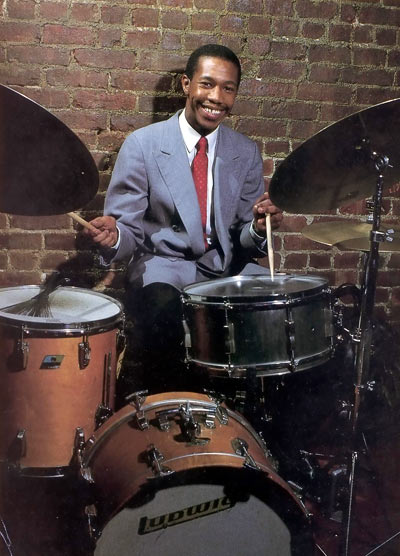
Today here's some footage of drummer Otis Brown III talking about his choice in cymbals brought to us by the fine people over at the Zildjian cymbal company:
Otis is a fine drummer that was first brought to my attention through his great playing with Joe Lovano's US Five project that features not one but two great drummers (along with his drum brother Francisco Mela holding down the rhythm fort). Brown is also a frequent accomplice of bassist Esperanza Spalding, the fine young musician who recently won the Grammy award for best new artist. Fine company to be in, indeed !
Some footage today of one of my all-time favorite groups, the Gateway Trio featuring Jack DeJohnette, Dave Holland and John Abercrombie:
I have bassist Sage Reynolds to thank for turning me on to this great band during one of our many frequent excursions to the used CD and record store "Cheap Thrills" in Montreal on Rue Metcalfe during my time at McGill University during the mid 1990s.
Here's a few great examples of how to translate Brazilian rhythms to the drum set in a very musical way.
Thanks to Mark Eisenman who brought this great clip to my attention via the Facebook, here's guitarist Ed Bickert with bassist Dave Young and the masterful Terry Clarke on drums performing a great rendition of "Street of Dreams":
Terry has a real grasp of playing Samba and Bossa Nova on the drum set. From my time hanging out and studying with him in Toronto I know that he was very much influenced by Brazilian Jazz drummer Duduka Da Fonseca during his time in New York City. Duduka is also the author of the acclaimed book "Brazilian Rhythms for Drum set".
During our lessons Terry also sang the praises of Sergio Gomes' recent method book "New Ways of Brazilian Drumming" which everyone should definitely check out:
I caught Sergio's clinic at the 2008 IAJE convention in Toronto and his playing and method was outstanding.
And since I'm on a bit of a Steve Gadd kick these days, here's a few videos of Gadd demonstrating his fine approach to playing Brazilian rhythms on the drums:
If you are interested in getting your shuffle together, watch these as performed by the master:
And I know this isn't a shuffle, but I thought it was pretty cool anyways....here's Steve Gadd in a groovy latin drum set duet with percussionist Airto Moreira:
Some footage today of percussionist Ralph Irizarry from his excellent session at this past years PASIC 2010 convention in Indianapolis:
Vic Firth has also posted clips of his clinic here and they are all worth checking out if you are interested in learning about authentic Salsa rhythms.
On an unrelated note, pianist George Shearing passed away yesterday. Here's an impressive clip that also features Shearing with drummer Denzil Best on Best's bebop anthem "Move":
I only had the occasion to hear Shearing play live once, in a duet with Canadian bassist Neil Swainson, at the Saskatchewan Jazz Festival in 1996. It was impressive, if for nothing else, to hear his famous block chord voicings in person that night !
It's been a fun and busy few weeks travelling across Western Canada working with great musicians and teaching great students. But it's nice to be back home in Calgary and now with my laptop back in tip top shape I'm ready to go...
-I had the opportunity to do a lot of listening to a lot of great music during my travels lately. In particular, the drive between Regina and Calgary is pretty uneventful, so my car's CD player always gets a good workout ! Here's a few albums that made the drive more tolerable:
Wynton Kelly Trio with Wes Montgomery "Smokin' at The Half Note" - Jimmy Cobb, drums
Dave Liebman & Phil Markowitz "Manhattan Dialogues"
-A few readers took a shot at identifying my red sparkle drums from last week's post (a Valentine's Day special perhaps?) So for all the gear heads out there, this "frankenstein" kit consists of the following:
-12x8 and 14x12 Premier XPK toms (early 90s vintage and from the first kit I ever purchased!) with custom wood hoops made by Jody Lutz over at Stellar Drums & Hoops. The original finish was a black wrap and I had Ed Peck from EPEK Percussion recover them in a slick red sparkle wrap.
The wood hoops look and sound great. They really give the toms a warm, round sound and feel, even when cranked up for relatively higher tunings. I really appreciate the fact that they are more subtle and less bulky than the Ayotte or Yamaha style hoops.
-16x14 bass drum with matching red sparkle wrap custom made by Billy Blast drums from Orange County, California. Billy does fantastic work as well. The bass drum has a Gretsch decal on it as it was the only 16" inch Remo coated ambassador bass drum head I could find in Calgary (!)
-Only one reader managed to identify my snare drum in that setup, a 14x5.5 Yamaha Roy Haynes Signature Copper snare. It's a fine drum but damn is it heavy...
These are really fun drums to play around with these days. I originally considered selling the Premier kit about a year ago but I'm really glad that I hung onto them and invested some time and money into bringing some new life to them. I've put a lot of drumming kilometers on that kit over the years.
Here's a couple of interesting clips I came across lately to keep everyone entertained:
-Bill Stewart and Bill Carrothers piano/drums duet:
If you haven't heard the duet album these two already released, check it out !
-Yet another fine Max Roach piano & drums duet, this time featuring pianist Mal Waldron:
-And to finish out off today's Monday Morning Paradiddle, here's some brief (and rare!) footage of Toronto Jazz drummer Bob McLaren in action:
Bob is a great, hard swinging drummer and a good friend. I had the privilege of studying with Bob for a year during my time at the University of Toronto. His approach to Jazz coordination on the drum set is compelling and in depth. Make sure to check out Bob out whenever you can !
I'm currently teaching in Saskatchewan, slowly making my way home to Alberta. So between that and with my laptop in the shop these days getting its logic board replaced my blogging will be light for awhile...(what is a logic board anyways???)
In the meantime, here's a few pics of one of my drum sets from a recent rehearsal with Calgary's distinguished contemporary dance company, Decidedly Jazz Danceworks. I'm playing with the upcoming DJD production entitled "Wilds" for the month of March and looking forward to working with resident choreographer Kimberly Cooper, musical director/bassist Rubim De Toldeo and the rest of the highly talented troupe of dancers & musicians. More on this later...
So anyways here's some photos of my drums (because I haven't much else to blog about today!) I'm no Jesse Cahill when it comes to Jazz drumming-photography.....but if you can name what brand(s) of drums these are, you will win a special Four On The Floor prize!
HINT: There are FOUR brands of drums represented here and NONE of them are made by Gretsch : )
And also, with apologies to Chad Anderson....I know, the bass drum lifter and muffling towel on the 16" inch bass drum is cheating. Don't worry, I'll "get it" eventually...
Montreal Drummer Efa Etoroma Jr. kindly sent me a copy of his band's recent EPK and, as a promised, I gave it a listen to present you a sort of review today (sorry it took me so long...)
Efa and his crew (I believe) are all current/former students at McGill University's Jazz program of which I am also an alumni. So it's great to see the high level of students continue to come through that program and always nice to see young musicians taking the initiative with such a project.
Here's a recent bio of the band from their website:
"Originally formed in January 2009 the Ruckus Fo’tet is a Hip Hop ensemble with influences stemming from modern Jazz, Hip-hop, Rock,Funk, and Latin genres. The members of the group met while attending the McGill Schulich School of Music’s Jazz Program in Montreal, Quebec, Canada. Performing chiefly original material, the group’s compositions draw influence from artists such as Herbie Hancock, J Dilla, Jimi Hendrix, James Brown and Antonio Carlos Jobim. Although previously known as an instrumental ensemble, the Fo'tet exclusively collaborates with Montreal's esteemed MC Milla Thyme. In Montreal the Fo’tet has a reputation on the live music scene with recent performances at the 2009 Montreal International Jazz Festival, 2010 McGill Nuit Blanche and Open Air Pub events, as well as with performances at notable venues such as Upstairs Jazz Club, L’Absythne, Jupiter Room and Trois Minots.
Known for their soulful originals and deep in-the-pocket grooves, the Fo’tet takes pride in delivering performances that are both groovy and intellectual. The combination of groove, thoughtful arrangements, and Jazz-inflected improvisational elements make the ensemble’s music accessible to anyone from the jazz aficionado to hip-hop lover to rock enthusiast and to the casual music listener. The group’s distinct electro-acoustic sound is cumulated via the combination of acoustic drums, tenor saxophone, electric bass, and electric guitar."
The music presented on this EPK represents an enjoyable approach to a funky backbeat/hip-hop style of contemporary Jazz. Efa is a great young drummer and the influence of such contemporary drummers as Chris Dave and Questlove was obvious from the first few bars. He plays his backbeats and grooves with a lot of discipline and overall musicality and demonstrates a real maturity in an age where many young drummers seem to try and prove themselves with the number of notes they play rather than how they play them.
All the tracks I heard had a nice forward driving vibe without feeling overally aggressive or edgy and all with a certain casual/relaxed and in-the-pocket attitude towards establishing a nice solid groove (in a good way). This is the kind of music I could easily sit, chill out, relax and listen to during a night out.
I was particularly impressed with the recording quality of the tracks they sent. It was obvious that they took great care in the production quality of the recording process and it really shows.
My only potential criticism is that it would have been nice to hear these guys stretch out more with some more open blowing and take more chances within the context of the nice grooves and vibe they clearly establish so well. However, I'm pretty sure I would be pleasantly surprised and satisfied if I had the opportunity to hear this unit live (ie. come to Calgary, please!)
The Ruckus Fo'Tet - "1-2-3-Fo'"
Tracks:
Future Blues
Speechless
The D
This Is
The Ruckus Fo’tet is comprised of:
Jarryd Torff - Tenor Saxophone
Evan Stewart - Electric Bass
Dave Ison- Electric Guitar
Efa Etoroma, Jr.- Drums and Cymbals
Max Miller- MC
Here is also a nice clip of the Ruckus Fo'tet from a recent performance in Montreal:
For more information about this band you can find them here: www.ruckusgroup.com
A burning clip here today to finish the week off featuring a very young Kenny Washington on drums tearing it up with tenor saxophonist Johnny Griffin on his composition "Blues For Harvey":
Another interesting drummer/keyboard duet today featuring Bob Moses and John Medeski:
THE BUSCHMEYER-McCASLIN-STOLL B3 ORGAN PROJECT WOULD LIKE TO THANK...
I would also like to take this opportunity today to thank everyone who came out to our concert last night presented by the Cliff Bungalow Jazz Series in Calgary. Producer and local Jazz enthusiast Jan Mulder went above and beyond the call of duty to promote this show and the word is clearly getting out as we packed the room and set a new attendance record. We actually ran out of chairs and a few resilient people had to resort to standing against the back wall or pulling out a few couches to sit on.
Keyboardist Derek Stoll and Ralf Buschmeyer played their tails off and we all really appreciated the enthusiastic audience last night. Thanks again for your support and the continuing success of this initiative certainly goes to prove that Jazz music and Jazz audiences are alive and well in Calgary despite all the doom and gloom in the media after the demise of the Calgary Jazz Festival and C-Jazz.
Hello everyone. It's been awhile since my last post as it has been an eventful 10 days having played across Western Canada with an exciting eleven piece band, performing all the music and arrangements from the seminal album "Art Pepper+11". Overall our small tour was a resounding success. I'd like to thank Dean McNeill for going above and beyond the call of duty in organizing this tour as it was no small feat at all. We drove many kilometers, shared many laughs and played some great music. Fortunately our show was recorded by the CBC during our performance in Saskatoon at the University of Saskatchewan so we'll be able to share some of this music with the rest of the world in the coming months.
There wasn't much time for blogging as I didn't travel with my laptop and only had my iPhone to communicate with the outside world. But here are a few things that caught my attention during my rare downtime while on the road:
-Drummer, blogger and harmonica whiz (!) Ted Warren continues his series of great interviews over at his blog Trap'd this time featuring tenor saxophonist Jerry Bergonzi. Bergonzi had the following interesting comment to say about the importance of studying rhythm:
"I think that everyone should study drums as time and rhythm are the most important things in playing. As you told me once, "It is Harmony and Melody that have fucked up music" I really took that to heart and I try to play with as little melody and harmony as possible now. I have even stripped down my tenor so it only plays 5 notes now."
Food for thought, indeed.
I was fortunate to hear Bergonzi play in Toronto in the basement of some posh private society club a couple of years ago with Ted at the drum helm along with Mike Downes on bass and Brian Dickinson on piano. The playing was, of course, phenomenal but the rhythm section was absolutely amazing in itself. A perfect example of how it's supposed to be done...
-I spent much of my time over the past ten days driving across Alberta/Saskatchewan/Manitoba in the company of saxophonist's Jim Brenan, Bill Prouten and Greg Gatien. So we listened to ALOT of Michael Brecker, Ralph Bowen, a good fill of early Duke Ellington (from the Blanton/Webster band era courtesy of Bill) and a nice dose of 70's funk. I also learned alot about tenor mouthpieces, ligatures and saxophone vibrato. I love hanging out with musicians that like to talk shop!
-Drummer Willie Jones III is also fun to listen to and watch. Here's a couple clips of him unleashing, taken by a couple of amateur videographers:
-Another interesting clip that's been making the rounds over at cymbalholics.com featuring John Riley playing through perhaps one of the most impressive collections of vintage K. Zildjian cymbals I've ever seen (!):
-And last but not least former Globe & Mail Jazz critic Mark Miller sent me this amazing footage of saxophonist Lucky Thompson playing with none other than the great Kenny Clarke on drums:
-Finally, a few people I'd like to thank for their music and for being overall really nice human beings: Dean McNeill, Dave Morgan, Brad Shigeta, Jeff Preslaff, Carsten Rubeling, Greg Gatien, Jim Brenan, Bill Prouten, Will Bonness, John Hyde, Jim Head, CBC Radio, the University of Saskatchewan, Brandon University, the Yardbird Suite, the Beatniq Jazz & Social Club, the University of Regina, Campbell Collegiate, Mr. & Mrs. McNeill, Kevin Marsh, Jennifer McAllister, Nick Fanner, Kathy Anderson, Brent Ghiglione, Mayfair United Church, the McNeill's in Sherwood Park and Roy Sydiaha.
It's good to be back. More regular posts forthcoming...
THE BUSCHMEYER-McCASLIN-STOLL B3 JAZZ ORGAN PROJECT
WEDNESDAY, FEBRUARY 2nd 2010 8:00pm
THE CLIFF BUNGALOW MISSION COMMUNITY CENTRE
2201 CLIFF STREET SW
$15/$10 (for students and community members)
info: 403.650.7695 www.cliffbungalowmission.com
The Buschmeyer-McCaslin-Stoll B3 Organ Project is the latest collaboration between Calgary jazz artists Ralf Buschmeyer on guitar, Derek Stoll on keyboards and Jon McCaslin on drums. Evoking the sounds of the classic jazz organ trios of the 1960s, these artists have come together to present an evening of grooving and hard swinging music inspired by such artists as Wes Montgomery, Grant Green, George Benson, Stanley Turrentine, Jimmy Smith and Larry Young. The groups repertoire will focus on classic jazz standards and compositions drawn from the classic jazz organ trio era.
About the Cliff Bungalow-Mission Jazz Series:
After an exciting start the CBM Jazz concert series is now in its second season. Organized by local jazz enthusiast, saxophonist and composer Jan Mulder, the monthly series of concerts features some of Calgary's best jazz musicians and ensembles and provides an ideal opportunity to spend a relaxing evening. The concerts are conducted in the quiet listening and family friendly environment of the Cliff Bungalow-Mission community hall and take place on the first wednesday of every month. Each 2 hour performance starts at 8 pm so everybody can get a good night sleep and be rested the next morning. Coffee, tea, and beverages are served. There is a $15 cover fee for each event ($10 for community association members and students). Tickets are sold at the door. Call 403-650-7695 for more info.
I'm headed on a tour of Alberta, Saskatchewan and Manitoba imminently with trumpeter/composer/swell guy Dean McNeill and an ensemble consisting of many of Western Canada's finest Jazz artists. We'll be performing music from the seminal album "Art Pepper+11" and newly commissioned compositions and arrangements written by members of the band specifically for this tour. Come by and say hello if you're in the neighborhood!
The Dean McNeill "Art Pepper+11" Western Canadian Tour
Featuring:
Dean McNeill, Dave Morgan - Trumpets Greg Gatien, Jim Brenan, Bill Prouten - Saxophones Brad Shigeta, Jeff Presslaff, Carsten Rubeling - Trombones Will Bonness - Piano John Hyde - Bass Jon McCaslin - Drums (pretending to be Mel Lewis...)
Tour Dates:
Saturday, January 22 - The Yardbird Suite - Edmonton, Alberta
Sunday, January 23 - Mayfair United Church, Jazz Vespers Series - Saskatoon, Saskatchewan
Normally I would highly recommend checking out both of these artists on any day on whatever recordings you can find (they are both outstanding musicians - complete virtuoso's with dynamic individual voices). Fortunately for us here they are creating some great music together:
Hey, I'm co-hosting the jam session at the Beatniq Jazz & Social Club tomorrow evening starting at 9:00pm with guitarist Ralf Buschmeyer and bassist Wes Caswell.
Come on by, sit in for a few tunes and say hello !
The Ralf Buschmeyer Trio hosts the Beatniq Jam Session
Thursday, January 20th 9:00pm The Beatniq Jazz & Social Club 811 - 1st Street SW Calgary, Alberta
Ralf is one of Western Canada's guitar greats and a consummate musician. His influences range from Grant Green & Wes Montgomery to Lorne Lofsky, Ed Bickert, Mike Stern, Pat Metheny and John Scofield. Ralf can swing hard and then rock out when it counts. It's always a pleasure to play with Ralf and it will be for sure a fun night of music ahead of us tomorrow evening. Don't miss it!
A couple clips of Al Foster for you to enjoy today:
I think the first album with Al Foster that really got my attention was Joe Henderson's "The State of The Tenor" (a great live trio date with Ron Carter on bass recorded at the Village Vanguard). I've been playing a lot of Joe Henderson tunes with Jim Brenan lately, so this one has been getting a lot of airplay around my house these days. Blue Mitchell's "The Thing To Do" is also a great one featuring a very young "Aloysius" Foster on drums (dig his funky calypso beat on "Fungii Mama") and definitely required listening if you ever hope to have a conversation about Jazz with Kevin Dean !
(just a little shout out there to all my faithful readers in Quebec, St. Pierre & Miquelon, Corsica and French Guyana...merci!)
-As drummers, our most important ally on the bandstand is the bass player. It's also hard to think of how hard a great drummer swings without thinking of the bass player they are playing with! The two go hand in hand. Just think of all the great drummer + bass player combinations who have played together over the course of Jazz history and you'll know why.
I've been very fortunate to have played with many outstanding bass players over the years and each of them have taught me, in some way or another, the meaning of swing.
A few of these fine bassists that I'm indebted to include:
Rob Hutchinson, Carlo Petrovitch, Peter Dyksman, Sage Reynolds, Derek Shirley, Dave Watts, Jodi Proznick, Tommy Babbins, Alec Walkington, Michel Donato, Rufus Reid, Don Thompson, Solon McDade, Charlie Biddle, Ron Seguin, Rob Fahie, Adam Over, Jim Vivian, Zack Lober, Brian Hurley, Karine Chapdelaine, Dennis Irwin, Ben Allison, Mike Downes, John Clayton, Kieran Overs, Kristin Korb, Tim Harley, John Taylor, Aryeh Korbrinksy, John Hyde, Rubim De Toledo, Johannes Weidenmueller, Miles Perkin, John Patitucci, Fraser Hollins, Stefano Valdo, Andrew Downing, Chris Jennings, Ricardo Del Fra, Sean Cronin and many others...
Thank you.
Furthermore, I think it's worth spending some time studying great bass players just as we study great drummers (I have my old teacher Chris McCann to thank for this insight. He once asked me to describe and compare the differences between Ray Brown, Sam Jones and George Tucker! Whoa...I didn't have a clue.)
A few great bass resources that I've been checking out lately to that effect:
"Charles Mingus: More Than A Fakebook" by Andrew Homzy
Probably the most definitive resource on the music of Charles Mingus out there.
"The Jazz Bass Book" by John Goldsby
This book is an amazing overview of Jazz bass from both a historical and technical perspective.
"The Evolving Bassist" by Rufus Reid DVD
This is a great bass lesson but dig the great trio playing with Lewis Nash and Mulgrew Miller as well !
-To finish today's posts here's a real gem to enjoy. Trumpeter and visionary Dave Douglas contributed this footage to his blog. Here's the great Duke Ellington and his orchestra performing "Isfahan" from the Far East Suite featuring Johnny Hodges on alto saxophone:
And while we're on the topic of Duke Ellington, this one never fails to inspire me...
Some swinging brush playing here from Jeff Hamilton and Steve Smith:
I was shocked to watch how high Hamilton brings back his brush strokes while playing. That in itself was this weekend's lesson in brush technique....The control and gracefulness is all without a doubt really quite impressive (and of course THEN consider the acrobatics!)
Just a quick clip today of drummer Alan Dawson killing it with Bill Evans and Lee Konitz:
It's funny. Everytime I use or hear the word "killing" with reference to Jazz music I can't help but think of myself as being like one of those dorky youtube Jazz robots that have been making the rounds lately. Killing!
Drummer and author Malcolm "Mac" Santiago was very kind to forward me a copy of his latest book entitled "Beyond The Metronome: Becoming an Inchronus Musician".
Santiago defines the term "Inchronus" as the following:
in•chro•nous (ĭnʹ krôn- s) adj. Exhibiting an ability to play rhythm accurately in steady time without the aid of a metronome, recorded music, or other musicians . . . what many experienced musicians refer to as your internal clock.
Once I read his definition and introduction and understood that his book was about the topic of TIME, I was immediately interested and caught my attention. Developing a good sense and understanding of TIME should be a priority for any musician (not just drummers) of any style. Dealing with rhythm, and the issue of TIME specifically, is often accepted however how it is to be taught effectively and implemented often remains a mystery for many students and teachers of the music. Many people recognize the importance of having good TIME but when it comes to explaining how to teach that concept, many often just say "play along with a metronome" or shrug their shoulders. Well, there is obviously more to the science of musical time than simply playing along to a steady click and drummer/author Mac Santiago has developed a very interesting method and set of philosophies to help develop, specifically, a musician's "inner clock" and further one's feeling of TIME at a deeper, more personal level rather than simply being able to follow along with a click or metronome (but of course that's certainly that's part of it as well).
The book includes a CD containing .mp3's of various metronomic "click" exercises and routines at different tempos, all developed with the aim of improving one's sense of internal time. The overall goal of this book is to help us develop a strong personal sense of time without relying too much on external references. The author has done this by focusing on working with recorded click tracks designed to force one to rely on there own personal clock. For example, by working with "elongated" click tracks (click tracks where the subdivision gradually changes from quarter notes to half notes, to whole notes, etc.) and "diminished" tracks (where the pulse remains constant however the volume gradually decreases) one is required to shed any rhythmic insecurities one might have in order to properly execute a particular exercise and concept. Challenging stuff indeed !
The book is divided into two parts: Part One "The Tools of Inchronation" and Part Two "Concepts and Applications" and all the chapters use the extensive accompanying click track exercises contained on the CD.
The first part "Tools of Inchronation" deals with what Santiago describes as "concepts and exercises to help you get a deeper understanding of what steady time feels like - recognizing it, internalizing it, and finally creating it in the manner of your choosing" and the second part "Concepts and Applications" deals with "some real-life experiences that every musician goes through when exploring rhythm and tempo".
Between Santiago's well thought out explanations and philosophies of our relationship to the concepts of pulse, rhythmic subdivisions, etc. and the technical click exercises contained on the CD, this is overall an excellent resource to invest some time in if you are serious about furthering your personal relationship to TIME and rhythm.
You can find further information regarding this unique approach and resource to developing your sense of time here: http://inchronicity.com/
Here's the multi-talented entertainer Sammy Davis Jr. playing drums in a tribute to Eddie Condon on a piece entitled "A Message From Goldfinger":
I'm quite impressed (I really dig the obvious Gene and Buddy influence in there!) and special thanks to Clayton Cameron (a former Davis sideman) for bringing this one to my attention via the Facebook.
Toronto drummer/blogger Ted Warren was nice enough to interview me for his blog Trap'd over here awhile ago. I thought I would return the favor by hijacking Ted's questions and turn the tables on him this time!
I've known Ted since I was a high school "stage" band drummer, growing up in Regina, Saskatchewan and, like Ted, had gone though the ranks of the Regina Lions Band. It was always inspiring to hear Ted when he would swing through Regina, usually touring with a Canada Council sponsored Jazz group. In fact, my first recollection of hearing him play was at a performance promoted by the Regina Jazz Society (at the University of Regina Faculty club) by the John Stetch Quartet featuring John Stetch on piano, Mike Murley on tenor, Jim Vivian on bass and Ted on drums. John was playing music from his debut album "Rectangle Man" (which to this day remains an important album in my development) and it was overall a very memorable experience. It was the first time I heard a group from Toronto/Montreal, the first time I heard Jazz music that was based on a loose, broken straight eighth feel rather than swing and the first time I heard a Jazz drummer play a drum solo with mallets ("You are allowed do that???" I asked my myself!)
Ted is a true student of the music and his musicality and tireless work ethic are quite inspiring. When I lived in Toronto I always made a point of going to hear Ted play, often as a sideman with many of Toronto's finest but also with his own fine group Ted's Warren Commission. Ted is also a great composer and his overall creativity is a generous force to behold. Check out his band's albums "First Time Caller" and "Songs For Doug". I've also really been digging his playing on Michelle Gregoire's album "Reaching" lately.
Here's a biography (copied from somewhere on the web) in case you aren't familiar with Ted's impressive resume:
Ted has a solid reputation as a musical, versatile drummer. He is an active member of Canada’s jazz scene and has been recognized with Jazz Report’s Drummer of the Year award. He teaches at Humber and Mohawk College in their Jazz Studies programs and is a well-regarded clinician and adjudicator. Ted fronts his own quartet, Ted’s Warren Commission, which has just released their debut CD, First Time Caller. He is a member of the Mike Murley, Mike Downes, Kieran Overs, and Ted Quinlan groups. He was the drummer for the Boss Brass and can be heard on six of their recent CDs, including Velvet and Brass (with Mel Torme), From Lush to Lively (with Oliver Jones), Even Canadians get the Blues, and The Boss Brass Plays the Jazz Classics.
Ted studied music at McGill and received a certificate in Jazz Studies from St. Francis Xavier University. He has worked with many acclaimed performers, including Slide Hampton, Bob Newhart, Maynard Ferguson, Lew Soloff, Chuck Mangione, Jeff Healey, Norma Winstone, Howard Johnson, Nick Brignola, Kenny Wheeler, and Gerry Bergonzi. Ted’s extensive touring has taken him to Poland, South Korea, Spain, Brazil, Iceland, and Japan. He has also performed at Carnegie Hall with harpist Joanna Jordon. In addition to his other recorded work, you can hear Ted on Mike Murley’s CDs Extra Time, and the Jazz Report’s Album of the Year recipient, Conversation Piece. You can also hear Ted on the Juno Award winning Tales from the Blue Lounge by Richard Underhill. Ted endorses Vic Firth drumsticks and Zildjian cymbals.
And here's an impressive clip of Ted's drumming (stolen from his blog), demonstrating how to 'comp' using quarter notes at really fast tempos:
Wow...
Now....finally here's the interview with Ted (featuring Ted's questions!):
1) As well as working frequently as a sideman, you also lead bands and compose for them. What do you think other instrumentalists can learn about these disciplines from drummers?
I feel drummers are very concerned with the mood and shape of music, and how the tempo and feel of a piece affects it's mood and shape. I think often other instrumentalists can be overly concerned with other aspects of music (harmony is one frequently occurring example) and might miss the fact, for instance, that most of the tunes they play are the same tempo.
2) Can you name a recording that was particularly influential to you?
I still can remember the first time I heard Miles Davis' "Seven Steps To Heaven" with Tony Williams on drums. I was in 9th grade and a friend played it for me when we were hanging around in his basement one day after school. Even though I didn't have a clue what they were doing I thought to myself, "What a cool tune!" and " What a REALLY COOL drum solo!"
3) Can you name a profound live performance?
There have been many. I have been fortunate to see some great musicians who are no longer with us (Mel Lewis, Dannie Richmond, Dewey Redman, Max Roach,Tony Williams, Vernel Fournier, Elvin, Junior Cook, Ray Brown). I have also gotten to see Keith Jarrett, Jack DeJohnette, and David Liebman quite a few times, which had been very inspiring. I think for me, every time I've seen Bill Hart play is important to mention, because he always gives me the feeling that something special, profound, and unique is happening. I'm striving to give people that same sense when I play.
4) What are your current goals in drumming, teaching, and music?
I plan to keep working and practicing at many aspects of music. As well as drums, I have been working at playing piano and harmonica, which has completely widened my perspective on music. ( We've got to get that band together of all-drummers-playing-different-instruments Jon!) My trio with Rich Brown and Mike Murley is releasing it's debut recording soon, and we're doing a tour in March. I'm almost finished my Bachelors in music. I plan to keep teaching, both privately and in institutions, as much as I can and keep doing lots of clinics. All that should keep me out of trouble for awhile!
5) Has your blog changed your approach to playing or teaching?
I initially started the blog at my wife's suggestion and didn't really know what to do with it until I started reading "Four on the Floor" and some other peer's blogs. I then figured out the tone, format and content that would be appropriate for me. It's changed my teaching in that on the blog I can put out anything I feel is important without having to answer to anyone else and I can often get into greater depth than is possible in a lesson or a clinic. The blog has changed my approach to playing in that now a lot of my exchange of ideas and thoughts with other drummers happens online. I rarely am on a gig with other drummers, we all have busy lives and careers etc, and often there are great geographical distances between us. It's interesting, because several years ago Dennis Mackrel mentioned he thought the net was the new "hang" for musicians. That's certainly been the case for me.
6) Why is everyone from Regina, Saskatchewan obsessed with football and pizza?
It's a puzzling question. I always find it a little sad how uninterested Central Canadians are in the CFL. As far as pizza goes, I've never found anything that compares to Regina anywhere else in the world. Houston Pizza (circa 80s anyway) rules, by the way!
Not much to report today but here's a few things on my mind:
-I hit the Broken City Jam session on Saturday afternoon (keeping in my mind my previous two posts of jam session etiquette, of course!!!) and was treated to Edmonton's Jerrold Dubyk on tenor and Bill George on drums joined by my frequent Calgary comrades Rubim DeToledo on bass and Ralf Buschmeyer on guitar. Fine playing, as always, from all and Jim Brenan (tenor) and I sat in for a few numbers including a spirited, up tempo tenor battle on a rhythm changes.
It was also nice to see such a large crowd come out (although not that many musicians this week?) to support Calgary's premier and longest running jam session. This is a well run session and an important part of the local scene. Make sure to support your local jam session wherever you are.
-I stopped by Bob Everett's vintage drum shop BEAT IT in Calgary last week and marveled at his large collection of vintage Ludwig drum sets. If you are looking for a nice sounding, vintage Ludwig chrome-over-brass Superphonic snare drum, Bob is definitely the guy you should talk to.
He also had a set of thin 13" K.Zildjian hihats from the 1930s that sounded very nice. I played around with them and made a few interesting observations: They were really quite quiet when I played them with my left foot (2&4) no matter how hard I stomped on them (!) However, when I played them with my sticks (a la Jo Jones) they totally had that sound and feel that I would associate with the style of 1930s big band drumming. What really surprised me was how bright these hihats were but the more I thought about it, it really made sense. Of course drummers didn't really play 2 & 4 with their hihats back then, but the brighter sound when played with sticks would allow them to really cut through a full brass and horn section. I haven't played many old K.Zildjian hihats so this was a bit of a revelation for me.
-Here's a few more things that caught my attention over the weekend:
-Check out this great footage of drummer Joe LaBarbera performing with Larry Goldings:
I was fortunate to study and work with Joe at the Banff Centre for the Arts during the summer of 1997 and it's always a lesson in itself to check out his loose and flowing technique around the drums. I've actually been meaning to check out his album "Mark Time" as a leader for some time now.
-Here's a cool audio clip of Gregory Hutchinson performing "Nefertiti" with vocalist Jessica Desiree:
-And finally, here's the Master himself Roy Haynes (thanks to Bill in Minnesota for finding this one!):
Check out the expression of bassist John Patitucci as he watches Haynes play. I love that and wouldn't that be great if everyone treated their drummer's with that sort of reverence and respect ? : )
Today I'm going to explore a few variations on a classic Elvin Jones phrase.
I will use the following key to notate this:
R= Right Hand
L=Left Hand
F=Bass Drum (foot)
A common figure that Elvin Jones (among many, many other drummers!) made extensive use out of was the following triplet pattern that looks like this:
RLF RLF RLF RLF
You could also reverse the sticking and play it like this:
LRF LRF LRF LRF
To pull it off effectively, split the hands between different drums and experiment with playing the triplet phrase at different speeds and metric tempos (ie. as slow eighth notes, triplets, sixteenth notes, sixteenth note triplets, etc.)
I had the opportunity to play with Dave Liebman during a masterclass at McGill University many years ago and he pointed out (keep in mind here that Liebman is also himself a great drummer!) that Elvin would often play this phrase with the bass drum on the second beat instead of the third.
So that pattern would look like this:
RFL RFL RFL RFL
or:
LFR LFR LFR LFR
Now here's an interesting variation on that idea that I wanted to share that I've been having some fun with of late:
RFR LFL RFR LFL RFR LFL RFR LFL
So basically if you left out the bass drum your hands would be playing a swung/shuffle double stroke pattern like this:
ie. R R L L R R L L
Furthermore, divide your hands around the drum set and vary the tempo as before and you'll come up with some creative variations.
*Also, try substituting the hihat instead of the bass drum or mix it up between the two feet to further explore variations of these patterns.
A nice solo today from Steve Smith who demonstrates, very effectively, how to use a large array of tom toms all decked out in a very slick and stylish blue sparkle finish (which I'm told will be featured in the next Star Trek movie):
Dig the Tony Williams black dots on the drumheads. Nice!
The people over at Zildjian are doing a fine job at promoting their endorsers and providing some insight into their craft. Here's Terri Lyne Carrington giving us the inside score today:
A few more contributions to the proper etiquette of sitting in on a jam session from bassist Carlo Petrovitch (someone who's seen it all...)
25. Don't call a tune that you don't actually have a clue how to play.
26. If you don't know a tune; don't suggest that you'll play it from ear when you actually cannot play by ear.
27. If you don't know a tune; don't suggest that you'll read the chart when you have no idea how to read or transpose music at sight.
28. When you get lost in the changes and eventually stop soloing 10 measures short, don't look at the bass player to some how fix your awkward silence.
29. After a bass solo, play the melody out. If you're not paying attention to the form and forget to come in; don't ask the bassist if they are done soloing 10 bars into the form when it's clear that they where finished 10 bars ago.
30. When playing a really really really fast tune don't ask the bass player to play a solo, they are to busy playing bass.
31. Having a conversion on the band stand during the bass solo isn't a good idea, especially if the leader is the bass player.
32. Call Jazz tunes at a Jazz Jam session, not pop, rock, r&b, rap, space age funk or any combination thereof and expect anyone to know them.
33. If you play a horn please do not accompany behind the bass solo. If you are in the rhythm section you don’t always have to play behind the bass solo.
34. When calling a really obscure tune and the rhythm section admits to not knowing the changes; don’t reply with “Really you don’t know that tune?” Beware, the tables can turn on you in a hurry.
And finally, a wise piece of advice from trumpeter Patrick Boyle directed to those who might feel inclined to adopt a "drop in/parachute" style of sitting in on a session:
"It is also the height of lame for a jammer to play a tune and then leave the venue right away. It is polite to hang out, even for a little while, to listen to a few other players and generally contribute to a good vibe of a jam session."
The other day I had an interesting discussion with pianist Jeff McLeod (a fine musician studying at the Eastman School of Music) about the dynamics of the jam session. Having hosted my share of sessions at such places such as the Rex Hotel & Jazz Bar (Toronto) and Calgary's Broken City, it always amazes me as how to many people clearly don't get it...
The bottom line is this: check your ego at the door and use some common sense when sitting in ! A little professionalism goes a LONG way...
So here's a list that pops up frequently on the internet taken from the SaxOnTheWeb forum of a few things to consider when sitting in at your local session:
"Jazz Jam Session Etiquette" by Grant "King" Koeller
1. Don't be a solo hog. Say what you have to say in as few choruses as possible.
2. Don't cut another soloist off by jumping in.
3. If you don't know the tune, don't solo. Nobody wants to hear a person who hasn't paid their dues on their horn make a complete fool of himself by trying to make every one think he knows how to play.
4. Don't tell the leader what to do. It's their Jam. Not yours. You can always get your own jam someday.
5. Know when to play.
6. Know when to sit down and chill out and enjoy the other players.
7. Have respect for the other soloists ideas by not doodling' around on your ax when they are playing.
8. If the other players start to riff behind the soloist, then go ahead and join in, but remember the balance, don't cover the soloist up.
9. Remember the solo order so when fours come up, everybody gets a turn.
10. The Bass doesn't need a solo on every tune.
11. If there is more than one horn present don't all play the melody in unison. Use different harmony parts and chord tones to create interest.
12. When playing a Ballad, split up the choruses in half, so the tune isn't an hour long.
13. Don't insist on staying up on stage all night. Play your 3 or 4 songs and make room for the other soloists who haven't played yet.
14. Never be critical of another person on the bandstand. If you have something to say to someone about their pitch, tone, sense of time, or what ever, wait until the break.
15. Never be a mike hog. Always share.
16. Don't call tunes in order to impress somebody. No one wants to hear Carla Bley Tunes with no Bar Lines performed at the speed of Cherokee. Or Anthony Braxton tunes performed with a polka feel.
17. Learn some tunes that you love, and do them.
18. Don't judge other people's tunes. If you hate the song Stella by Starlight, instead of complaining about it, go sit down and take a break.
19. As a horn player, when the singer sings don't play. It's ok to fill in between their phrases as long as it's done tastefully.
20. Use space. Don't play every Jamie Abersold lick that you know in the first three minutes. Save some ideas for later.
21. Be Mature. A jam is supposed to be about mutual respect for all the players regardless of ability, and not just a cutting contest. There is no room for "Higher, louder, faster," types of players who want to show off.
22. If the person ahead of you just took 8 choruses on the blues, don't try to "better" him by playing more if you have nothing to say.
23. Play in tune with each other. Don't have the attitude that "I'm right, Everyone else is Flat".
24. When ending a tune, look to the Bass or piano player for signs as to which type of ending will be used. Is it the 3 times a charm ending? Or that everybody stops at the same time with tight cut off ending? Is the rhythm section going to put a turn around at the end and vamp for a while ending? Turn on your radar.
Thanks to the nice people over at the Evans Drum Heads company here's several more fine drum lessons with Peter Erskine, this time dealing with drum soloing concepts and some great ideas with regards to brush playing:
Happy New Year everyone. I hope you all had nice holiday in your respective parts of the world. I had a very nice break over the past few weeks but still found time to practice, play a few gigs and check out a few interesting things while enjoying the holiday break with my family.
Here are a few things I've been checking out lately:
-Adam Nussbaum forwarded me this very thought provoking article on Elvin Jones written by Irish blogger, bassist and rhythm guru extraordinaire Ronan Guilfoyle:
-Interested in checking out some crazy tunes ? I can highly recommend Herbie Nichols: The Unpublished Works by Roswell Rudd. Pianist Frank Kimbrough hipped me to this great resource/fake book and insight into one of Jazz music's forgotten geniuses a few years ago while I was doing some research about Nichols at the University of Toronto. Well almost forgotten...Canadian Jazz writer Mark Miller has also written an excellent biographical tome about the life of Herbie Nichols entitled Herbie Nichols: A Jazzist's Life Both are worth checking out and offer a glimpse into a genius that fame and recognition, for the most part, managed to pass by. However, thanks to people like Rudd, Miller and Kimbrough (and Ben Allison and the rest of the Jazz Composers Collective crew that recorded Nichol's unique compositions) we can learn from Herbie Nichol's brilliant compositions and musical legacy.
-Looking for another interesting drum method to add to your collection? I've been getting a lot of use from George Marsh's unique drum method entitled "Inner Drumming" lately. This is a very unique approach to movement and coordination on the drum set that incorporates elements of Tai Chi and a unique method of notating physical movement around the drums (using boxes and arrows). George was very nice to send me a copy of his book awhile ago and it has certainly opened my eyes and ears to how I physically move around the drums. Matt Wilson also alluded to George's method and how to develop a sense of physical "flow" on the drum set when I studied with him several years ago. George sent a couple copies of two of his album's entitled "Game, No Game" and "Yes And" that feature him in various improvisations with a couple of different pianists. You can learn more about George, his method and his music here.
-Wynton Marsalis was recently featured on 60 Minutes. Check out this interesting interview here:
Whether you like his music or not, it's hard to not to appreciate his passion for the music. Personally, I dig the man and his music.
-To finish the first Monday Morning Paradiddle of 2011, here's a fun clip of J@LC drummer Ali Jackson Jr. playing an homage to Max Roach's "Mr. Hihat" solo taken from his concert last year, "The Beats of New York":
This is a blog about jazz, jazz drumming and all things unrelated. Thanks for stopping by!
A Bit About Me...
Jonathan McCaslin was born in Winnipeg, Manitoba and raised in Regina, Saskatchewan. Jonathan began playing the drums at the age of nine. He progressed through the Regina Lions Junior Band and the music program at his high school, Campbell Collegiate, soon developing a passion for playing the drums and jazz. Ultimately, Jon's interest in music led him to enroll in the Jazz Studies program at McGill University, graduating with distinction in 1999.
While at McGill Jon had the opportunity to study with some of the finest jazz educators in the country including Gordon Foote, Kevin Dean, Jan Jarcyzk, Chris McCann, Andre White, Michel Lambert and Dave Laing. He also attended the prestigious summer jazz workshop presented by the Banff Centre for the Arts in 1997, where he performed with Canadian jazz greats Hugh Fraser, Don Thompson and Kenny Wheeler.
Jon has also been fortunate to have performed with many of Canada's jazz elite including Charlie Biddle, Brian Hurley, Louise Rose, Alaister Kay, Mart Kinny, Gary Guthman, Mike Rud, Hadley Caliman, Greg Clayton, Chase Sanborn, Andre White, Tilden Webb, John LaBelle, Kevin Dean, Dave Turner, Ralph Bowen, Don Thompson, Dionne Taylor, Jim Vivian, Kelly Jefferson, Ian McDougall, Brad Turner, Jim Brenan, The McGill Jazz Orchestra, Jeff Johnston, Lorraine Desmerais, Steve Amirault, Hugh Fraser, Chucho Valdes, Kieran Overs, The Altsys Jazz Orchestra, Pat LaBarbera, The Regina Symphony Orchestra and The Montreal Jazz Big Band.
In the spring of 2002 McCaslin completed his Master's in Jazz Studies at McGill University where he studied jazz drumming, improvisation and composition.
In January 2003 Jon released his debut CD, “McCallum’s Island”. Featuring his quintet, the CD contains an exciting collection of McCaslin’s original compositions, featuring himself and his band. The release of this CD was followed by a twenty-day tour of Western Canada, performing to enthusiastic, capacity audiences. During March of 2003 Jonathan was the recipient of a fellowship from the Kennedy Center for the Performing Arts and attended the “Betty Carter Jazz Ahead” residency in Washington, D.C. Along with twenty other distinguished young jazz artists, McCaslin was featured with such jazz icons as Terence Blanchard, Carmen Lundy, Winard Harper, Curtis Fuller and John Clayton.
McCaslin’s quintet performed at the 2003 edition of the Montreal International Jazz Festival and was nominated for the General Motors Grand Prix du Festival (awarded to the most outstanding Canadian group). From 2004 until 2006, Jon toured North America, Asia and Europe with the high-energy, critically acclaimed music production troupe “Barrage”. Featuring a cast of seven world-class fiddlers and a four-piece band, this dynamic show featured high-energy music and fiddle traditions from around the world set to upbeat choreography and movement.
In 2015, Dr. McCaslin received his Doctorate through the University of Toronto and completed his dissertation on the conceptualization of contemporary melodic jazz drumming. He is currently based in Calgary, Alberta where he maintains a busy performing and teaching schedule across Canada.